Mounting Type
Mounting Type refers to the method by which an electronic component is attached to a printed circuit board (PCB) or other surface. Common mounting types include:
* Through-hole: Component leads are inserted into holes in the PCB and soldered on the other side.
* Surface-mount: Component is placed on the surface of the PCB and soldered in place.
* Press-fit: Component is pressed into place on the PCB without soldering.
* Socket: Component is inserted into a socket on the PCB, allowing for easy replacement.
The mounting type is determined by factors such as the component's size, shape, and power requirements.
Surface Mount
Package / Case
Package / Case refers to the physical housing or enclosure that encapsulates an electronic component. It provides protection, facilitates handling, and enables electrical connections. The package type determines the component's size, shape, pin configuration, and mounting options. Common package types include DIP (dual in-line package), SOIC (small outline integrated circuit), and BGA (ball grid array). The package also influences the component's thermal and electrical performance.
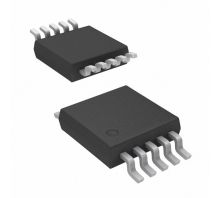
10-TFSOP, 10-MSOP (0.118, 3.00mm Width)
Supplier Device Package
10-MSOP
Operating Temperature
Operating Temperature is the range of temperatures at which an electronic component can function properly. It is typically specified in degrees Celsius (°C) and indicates the minimum and maximum temperatures at which the component can operate without experiencing damage or degradation. Operating Temperature is an important parameter to consider when designing electronic circuits, as it ensures that the components will function reliably in the intended operating environment.
-40°C~125°C
Tolerance
Tolerance in electronic components refers to the allowable deviation from the specified value. It indicates the range within which the actual value of the component can vary while still meeting the manufacturer's specifications. Tolerance is typically expressed as a percentage of the nominal value, such as ±5% or ±10%. A lower tolerance indicates a tighter range of acceptable values, resulting in more precise and consistent performance.
±20%
Feature
Selectable Address
Part Status
Part Status is an electronic component parameter that indicates the availability and production status of a component. It is typically used to inform customers about the availability of a component, whether it is in production, end-of-life, or obsolete. Part Status can also provide information about any restrictions or limitations on the component's use, such as whether it is only available for certain applications or if it has been discontinued.
Obsolete
Moisture Sensitivity Level (MSL)
Moisture Sensitivity Level (MSL) is a measure of the susceptibility of a surface mount electronic component to moisture-induced damage during soldering. It is classified into six levels, from 1 (least sensitive) to 6 (most sensitive). MSL is determined by the materials used in the component's construction, including the solderability of its terminals and the presence of moisture-absorbing materials. Components with higher MSL ratings require more stringent handling and storage conditions to prevent moisture absorption and subsequent damage during soldering.
1 (Unlimited)
Resistance
Resistance is a measure of the opposition to the flow of electric current in a conductor. It is measured in ohms (Ω). The higher the resistance, the more difficult it is for current to flow. Resistance is caused by the collisions of electrons with atoms and molecules in the conductor. The more collisions that occur, the higher the resistance.
100kOhm
Voltage - Supply
2.7V~5.5V
Configuration
Potentiometer
Interface
In electronics, an interface refers to the connection point or boundary between two or more electronic systems or devices. It defines the physical, electrical, and logical characteristics that enable communication and data exchange between them.
An interface specifies the protocols, pinouts, voltage levels, data formats, and other parameters necessary for the systems to interact seamlessly. It ensures compatibility and interoperability between different components or devices, allowing them to exchange information and perform their intended functions.
I2C
Number of Circuits
Number of Circuits refers to the number of independent signal paths within an electronic component. It indicates how many separate circuits or channels the component can handle simultaneously. For example, an operational amplifier with a Number of Circuits of 2 can amplify two separate input signals independently. This parameter is crucial for determining the component's functionality and its suitability for specific applications.
1
Memory Type
Memory Type refers to the type of memory technology used in an electronic device. It indicates the specific design and architecture of the memory, such as DRAM (Dynamic Random Access Memory), SRAM (Static Random Access Memory), ROM (Read-Only Memory), EEPROM (Electrically Erasable Programmable Read-Only Memory), or Flash memory. Each memory type has unique characteristics, including speed, capacity, volatility, and cost, which determine its suitability for different applications.
OTP
Number of Taps
Number of Taps refers to the number of connections or terminals available on a transformer or inductor. Each tap provides access to a different voltage level or impedance point within the component. By connecting to different taps, the user can adjust the output voltage or impedance to suit their specific application. The number of taps available determines the flexibility and versatility of the component.
256
Resistance - Wiper (Ω) (Typ)
160
Temperature Coefficient (Typ)
35ppm/°C
RoHS Status
ROHS3 Compliant
Description
The AD5170 is a 256-position, two-time programmable digital potentiometer that utilizes fuse link technology. It offers two opportunities for permanent programming of resistance settings. The AD5170 performs electronic adjustments like mechanical potentiometers, providing enhanced resolution, reliability, and low temperature coefficient performance. It is programmed via a 2-wire, PC-compatible digital interface, allowing unlimited adjustments before permanent setting.
Features
256-position digital potentiometer
Two-time programmable (TTP) for permanent resistance setting
Unlimited adjustments prior to one-time programming (OTP) activation
OTP overwrite for dynamic adjustments with user-defined preset
End-to-end resistance options: 2.5 kΩ, 10 kΩ, 50 kΩ, 100 kΩ
Compact 10-lead MSOP package (3 mm x 4.9 mm)
Fast settling time: 5 μs typical in power-up
Full read/write of wiper register
Power-on preset to midscale
Extra package address decode pins: ADD and AD1
Single supply: 2.7 V to 5.5 V
Low temperature coefficient: 35 ppm/°C
Low power: 6 μA maximum
Wide operating temperature: -40°C to 125°C
Evaluation board and software available
Applications
System calibration
Electronics level setting
Mechanical trimmers replacement in new designs
Permanent factory PCB settings
Transducer adjustment of pressure, temperature, position, chemical, and optical sensors
RF amplifier biasing
Automotive electronics adjustments
Gain control and offset adjustments