Factory Lead Time
10 Weeks
Mounting Type
Mounting Type refers to the method by which an electronic component is attached to a printed circuit board (PCB) or other surface. Common mounting types include:
* Through-hole: Component leads are inserted into holes in the PCB and soldered on the other side.
* Surface-mount: Component is placed on the surface of the PCB and soldered in place.
* Press-fit: Component is pressed into place on the PCB without soldering.
* Socket: Component is inserted into a socket on the PCB, allowing for easy replacement.
The mounting type is determined by factors such as the component's size, shape, and power requirements.
Through Hole
Package / Case
Package / Case refers to the physical housing or enclosure that encapsulates an electronic component. It provides protection, facilitates handling, and enables electrical connections. The package type determines the component's size, shape, pin configuration, and mounting options. Common package types include DIP (dual in-line package), SOIC (small outline integrated circuit), and BGA (ball grid array). The package also influences the component's thermal and electrical performance.
PCB Module
Operating Temperature
Operating Temperature is the range of temperatures at which an electronic component can function properly. It is typically specified in degrees Celsius (°C) and indicates the minimum and maximum temperatures at which the component can operate without experiencing damage or degradation. Operating Temperature is an important parameter to consider when designing electronic circuits, as it ensures that the components will function reliably in the intended operating environment.
0°C~70°C
Part Status
Part Status is an electronic component parameter that indicates the availability and production status of a component. It is typically used to inform customers about the availability of a component, whether it is in production, end-of-life, or obsolete. Part Status can also provide information about any restrictions or limitations on the component's use, such as whether it is only available for certain applications or if it has been discontinued.
Obsolete
Moisture Sensitivity Level (MSL)
Moisture Sensitivity Level (MSL) is a measure of the susceptibility of a surface mount electronic component to moisture-induced damage during soldering. It is classified into six levels, from 1 (least sensitive) to 6 (most sensitive). MSL is determined by the materials used in the component's construction, including the solderability of its terminals and the presence of moisture-absorbing materials. Components with higher MSL ratings require more stringent handling and storage conditions to prevent moisture absorption and subsequent damage during soldering.
3 (168 Hours)
Voltage - Supply
2.4V~3.6V
Frequency
Frequency, in the context of electronic components, refers to the rate at which an alternating current or voltage changes direction per second. It is measured in Hertz (Hz), which represents one cycle per second. Frequency is a crucial parameter for various electronic components, such as capacitors, inductors, and resonators. It determines the component's ability to store or release energy, filter signals, and resonate at specific frequencies. Understanding the frequency characteristics of electronic components is essential for designing and optimizing electronic circuits.
2.4GHz
Data Rate
Data rate, measured in bits per second (bps), is the rate at which data is transferred from one device to another. It is a measure of the speed of data transmission and is influenced by factors such as the bandwidth of the communication channel and the efficiency of the data encoding scheme. A higher data rate indicates faster data transfer, allowing for the transmission of more data in a given amount of time.
1Mbps
Utilized IC / Part
CYRF7936
RF Family/Standard
General ISM > 1GHZ
Antenna Type
Antenna Type refers to the physical design and characteristics of an antenna, which determines its radiation pattern, frequency range, and other performance parameters. It specifies the type of antenna, such as dipole, monopole, patch, or helical, and provides information about its shape, size, and construction materials. The Antenna Type parameter helps engineers select the appropriate antenna for a specific application based on factors such as coverage area, signal strength, and frequency requirements.
Antenna Not Included, U.FL
Current - Receiving
20.8mA~34.1mA
Current - Transmitting
18.4mA~21.2mA
Modulation
Modulation in electronic components refers to the process of varying one or more characteristics of a carrier signal (such as amplitude, frequency, or phase) in accordance with a modulating signal. This allows the modulating signal to be transmitted over a communication channel or stored in a recording medium. The modulation index is a measure of the extent to which the carrier signal is modulated.
DSSS, GFSK
Sensitivity (dBm)
-97 dBm
RoHS Status
RoHS Compliant
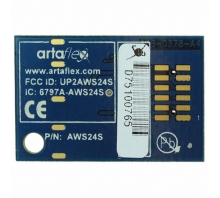
AWS24S Overview
The operating temperature range for this particular IC/part, the CYRF7936, is 0°C to 70°C. It is packaged in bulk, and its part status is listed as obsolete. The voltage supply for this IC/part is 2.4V to 3.6V. It falls under the general ISM > 1GHz RF family/standard and requires an antenna, which is not included but can be connected through a U.FL connector. When transmitting, the current needed is between 18.4mA and 21.2mA. The modulation used is DSSS and GFSK, and the sensitivity is -97dBm, making it suitable for a wide range of wireless communication applications. Despite its obsolete status, it still offers reliable performance within its specified parameters.
AWS24S Features
Through Hole
Bulk package
2.4V~3.6V volts
AWS24S Applications
There are a lot of Artaflex Inc.
AWS24S RF Transceiver Modules applications.
Power Amplifier (PA)
Low Noise Amplifier (LNA)
Transmit
Receive
Switch
Power management
Internet of Things (IoT)
Secure Payment
Home and Security
Health and Fitness
AWS24S More Descriptions
RF TXRX MODULE ISM>1GHZ U.FL ANT