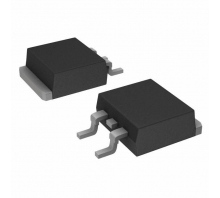
Mounting Type
Mounting Type refers to the method by which an electronic component is attached to a printed circuit board (PCB) or other surface. Common mounting types include:
* Through-hole: Component leads are inserted into holes in the PCB and soldered on the other side.
* Surface-mount: Component is placed on the surface of the PCB and soldered in place.
* Press-fit: Component is pressed into place on the PCB without soldering.
* Socket: Component is inserted into a socket on the PCB, allowing for easy replacement.
The mounting type is determined by factors such as the component's size, shape, and power requirements.
Surface Mount
Package / Case
Package / Case refers to the physical housing or enclosure that encapsulates an electronic component. It provides protection, facilitates handling, and enables electrical connections. The package type determines the component's size, shape, pin configuration, and mounting options. Common package types include DIP (dual in-line package), SOIC (small outline integrated circuit), and BGA (ball grid array). The package also influences the component's thermal and electrical performance.
TO-263-3, D2Pak (2 Leads Tab), TO-263AB
Operating Temperature
Operating Temperature is the range of temperatures at which an electronic component can function properly. It is typically specified in degrees Celsius (°C) and indicates the minimum and maximum temperatures at which the component can operate without experiencing damage or degradation. Operating Temperature is an important parameter to consider when designing electronic circuits, as it ensures that the components will function reliably in the intended operating environment.
-40°C~125°C
Part Status
Part Status is an electronic component parameter that indicates the availability and production status of a component. It is typically used to inform customers about the availability of a component, whether it is in production, end-of-life, or obsolete. Part Status can also provide information about any restrictions or limitations on the component's use, such as whether it is only available for certain applications or if it has been discontinued.
Obsolete
Moisture Sensitivity Level (MSL)
Moisture Sensitivity Level (MSL) is a measure of the susceptibility of a surface mount electronic component to moisture-induced damage during soldering. It is classified into six levels, from 1 (least sensitive) to 6 (most sensitive). MSL is determined by the materials used in the component's construction, including the solderability of its terminals and the presence of moisture-absorbing materials. Components with higher MSL ratings require more stringent handling and storage conditions to prevent moisture absorption and subsequent damage during soldering.
1 (Unlimited)
Terminal Finish
Tin/Lead (Sn80Pb20)
Subcategory
Other Regulators
Technology
Technology, in the context of electronic components, refers to the specific manufacturing process and materials used to create the component. It encompasses the semiconductor fabrication techniques, such as the type of transistor used (e.g., MOSFET, BJT), the gate oxide thickness, and the interconnect materials. Technology also includes the packaging type, such as surface mount or through-hole, and the leadframe or substrate material. The technology used impacts the component's performance characteristics, such as speed, power consumption, and reliability.
BIPOLAR
Peak Reflow Temperature (Cel)
240
Reach Compliance Code
not_compliant
Time@Peak Reflow Temperature-Max (s)
30
Number of Outputs
Number of Outputs refers to the number of independent output signals or channels that an electronic component can provide. It indicates the capability of the component to drive multiple external devices or circuits simultaneously. A higher number of outputs allows for greater flexibility and connectivity in electronic systems.
1
Qualification Status
Not Qualified
Output Voltage
Output Voltage is the voltage level produced by an electronic component when it is operating. It is typically measured in volts (V) and can be either positive or negative. The output voltage of a component is determined by its design and the input voltage applied to it. For example, a voltage regulator will produce a fixed output voltage regardless of the input voltage, while an amplifier will produce an output voltage that is proportional to the input voltage.
8V
Output Type
Output type refers to the type of signal or power that an electronic component can produce. It can be analog or digital, AC or DC, and can vary in voltage, current, or power levels. The output type is determined by the component's design and is crucial for matching it with other components in a circuit. Understanding the output type ensures proper signal processing, power delivery, and overall system functionality.
Fixed
Output Configuration
Output Configuration refers to the arrangement of output terminals or pins on an electronic component. It specifies the number, type, and arrangement of these terminals, allowing for various connection options. This parameter is crucial for determining the component's compatibility with other devices and ensuring proper signal flow within a circuit.
Positive
Voltage - Output (Min/Fixed)
8V
Number of Regulators
Number of Regulators refers to the quantity of voltage regulators present within an electronic component. Voltage regulators are circuits that maintain a constant voltage level, regardless of fluctuations in the input voltage or load current. The number of regulators indicates how many independent voltage regulation circuits are integrated into the component. This parameter is crucial for determining the component's ability to provide stable voltage to multiple circuits or devices.
1
Protection Features
Over Temperature, Short Circuit
Current - Quiescent (Iq)
6mA
Voltage Dropout (Max)
2V @ 1A Typ
Voltage Tolerance-Max
3.75%
Height Seated (Max)
4.572mm
RoHS Status
Non-RoHS Compliant
Description
The MC7800, MC7800A, MC7800AE, and NCV78001.0A are monolithic integrated circuits designed as fixed-voltage regulators for a wide range of applications, including local, on-card regulation. These regulators employ internal current limiting, thermal shutdown, and safe-area compensation. With adequate heatsinking, they can deliver output currents in excess of 1.0 A. Although designed primarily as fixed voltage regulators, these devices can be used with external components to obtain adjustable voltages and currents.
Features
Output Current in Excess of 1.0 A
No External Components Required
Internal Thermal Overload Protection
Internal Short Circuit Current Limiting
Output Transistor Safe-Area Compensation
Output Voltage Offered in 1.5%, 2%, and 4% Tolerance
Available in Surface Mount D-PAK-3, DPAK-3, and Standard 3-Lead Transistor Packages
NCV Prefix for Automotive and Other Applications Requiring Unique Site and Control Change Requirements; AEC-Q100 Qualified and PPAP Capable
Applications
Local, on-card regulation
Power supply for digital circuits
Power supply for analog circuits
Battery chargers
Voltage references