Factory Lead Time
12 Weeks
Mounting Type
Mounting Type refers to the method by which an electronic component is attached to a printed circuit board (PCB) or other surface. Common mounting types include:
* Through-hole: Component leads are inserted into holes in the PCB and soldered on the other side.
* Surface-mount: Component is placed on the surface of the PCB and soldered in place.
* Press-fit: Component is pressed into place on the PCB without soldering.
* Socket: Component is inserted into a socket on the PCB, allowing for easy replacement.
The mounting type is determined by factors such as the component's size, shape, and power requirements.
Surface Mount
Package / Case
Package / Case refers to the physical housing or enclosure that encapsulates an electronic component. It provides protection, facilitates handling, and enables electrical connections. The package type determines the component's size, shape, pin configuration, and mounting options. Common package types include DIP (dual in-line package), SOIC (small outline integrated circuit), and BGA (ball grid array). The package also influences the component's thermal and electrical performance.
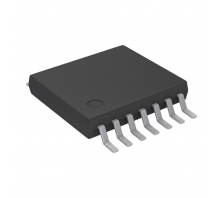
14-TSSOP (0.173, 4.40mm Width)
Number of Pins
Number of Pins: Indicates the number of electrical connections available on the component. These pins are used to connect the component to other components or circuits on a printed circuit board (PCB). The number of pins determines the functionality and connectivity options of the component. It is important to ensure that the component has the correct number of pins for the intended application.
14
Operating Temperature
Operating Temperature is the range of temperatures at which an electronic component can function properly. It is typically specified in degrees Celsius (°C) and indicates the minimum and maximum temperatures at which the component can operate without experiencing damage or degradation. Operating Temperature is an important parameter to consider when designing electronic circuits, as it ensures that the components will function reliably in the intended operating environment.
-40°C~125°C
Packaging
Tape & Reel (TR)
Tolerance
Tolerance in electronic components refers to the allowable deviation from the specified value. It indicates the range within which the actual value of the component can vary while still meeting the manufacturer's specifications. Tolerance is typically expressed as a percentage of the nominal value, such as ±5% or ±10%. A lower tolerance indicates a tighter range of acceptable values, resulting in more precise and consistent performance.
±20%
Part Status
Part Status is an electronic component parameter that indicates the availability and production status of a component. It is typically used to inform customers about the availability of a component, whether it is in production, end-of-life, or obsolete. Part Status can also provide information about any restrictions or limitations on the component's use, such as whether it is only available for certain applications or if it has been discontinued.
Active
Moisture Sensitivity Level (MSL)
Moisture Sensitivity Level (MSL) is a measure of the susceptibility of a surface mount electronic component to moisture-induced damage during soldering. It is classified into six levels, from 1 (least sensitive) to 6 (most sensitive). MSL is determined by the materials used in the component's construction, including the solderability of its terminals and the presence of moisture-absorbing materials. Components with higher MSL ratings require more stringent handling and storage conditions to prevent moisture absorption and subsequent damage during soldering.
1 (Unlimited)
Number of Terminations
14
Temperature Coefficient
Temperature Coefficient (TC) measures the relative change in a component's value due to temperature variations. It is expressed as a percentage change per degree Celsius (°C). A positive TC indicates an increase in value with increasing temperature, while a negative TC indicates a decrease. TC is crucial for ensuring stable circuit performance over a range of temperatures. It helps designers compensate for temperature-induced changes and maintain desired component characteristics.
150 ppm/°C
Resistance
Resistance is a measure of the opposition to the flow of electric current in a conductor. It is measured in ohms (Ω). The higher the resistance, the more difficult it is for current to flow. Resistance is caused by the collisions of electrons with atoms and molecules in the conductor. The more collisions that occur, the higher the resistance.
50kOhm
Number of Positions
Number of Positions, in the context of electronic components, refers to the number of distinct terminals or connection points available on the component. It indicates the number of individual electrical connections that can be made to the component. A higher number of positions typically allows for more complex functionality and versatility in circuit design.
128
Terminal Finish
Matte Tin (Sn) - annealed
Subcategory
Digital Potentiometers
Technology
Technology, in the context of electronic components, refers to the specific manufacturing process and materials used to create the component. It encompasses the semiconductor fabrication techniques, such as the type of transistor used (e.g., MOSFET, BJT), the gate oxide thickness, and the interconnect materials. Technology also includes the packaging type, such as surface mount or through-hole, and the leadframe or substrate material. The technology used impacts the component's performance characteristics, such as speed, power consumption, and reliability.
CMOS
Voltage - Supply
1.8V~5.5V
Peak Reflow Temperature (Cel)
260
Supply Voltage
Supply Voltage is the voltage required to power an electronic component. It is typically measured in volts (V) and is specified in the component's datasheet. The supply voltage must be within the specified range for the component to function properly. If the supply voltage is too low, the component may not function at all. If the supply voltage is too high, the component may be damaged.
2.7V
Reflow Temperature-Max (s)
40
Qualification Status
Not Qualified
Interface
In electronics, an interface refers to the connection point or boundary between two or more electronic systems or devices. It defines the physical, electrical, and logical characteristics that enable communication and data exchange between them.
An interface specifies the protocols, pinouts, voltage levels, data formats, and other parameters necessary for the systems to interact seamlessly. It ensures compatibility and interoperability between different components or devices, allowing them to exchange information and perform their intended functions.
SPI
Number of Circuits
Number of Circuits refers to the number of independent signal paths within an electronic component. It indicates how many separate circuits or channels the component can handle simultaneously. For example, an operational amplifier with a Number of Circuits of 2 can amplify two separate input signals independently. This parameter is crucial for determining the component's functionality and its suitability for specific applications.
4
Memory Type
Memory Type refers to the type of memory technology used in an electronic device. It indicates the specific design and architecture of the memory, such as DRAM (Dynamic Random Access Memory), SRAM (Static Random Access Memory), ROM (Read-Only Memory), EEPROM (Electrically Erasable Programmable Read-Only Memory), or Flash memory. Each memory type has unique characteristics, including speed, capacity, volatility, and cost, which determine its suitability for different applications.
Volatile
Converter Type
Converter Type refers to the type of conversion performed by an electronic component, such as an analog-to-digital converter (ADC) or a digital-to-analog converter (DAC). It specifies the input and output signal types that the converter can handle.
DIGITAL POTENTIOMETER
Bandwidth
Bandwidth, in the context of electronic components, refers to the range of frequencies over which a component can operate effectively. It is typically measured in Hertz (Hz) and indicates the component's ability to pass signals within a specific frequency range without significant attenuation or distortion. A higher bandwidth indicates a wider range of frequencies that the component can handle, while a lower bandwidth indicates a narrower range. Bandwidth is a crucial parameter for components such as amplifiers, filters, and communication systems, as it determines the frequency range over which they can perform their intended functions.
0.2 kHz
Number of Taps
Number of Taps refers to the number of connections or terminals available on a transformer or inductor. Each tap provides access to a different voltage level or impedance point within the component. By connecting to different taps, the user can adjust the output voltage or impedance to suit their specific application. The number of taps available determines the flexibility and versatility of the component.
129
Total Resistance
50000Ohm
Resistance - Wiper (Ω) (Typ)
75
Resistor Terminal Voltage-Max
5.5V
Height Seated (Max)
1.2mm
Length
Length, in the context of electronic components, refers to the physical dimension of a component along its longest axis. It is typically measured in millimeters (mm) or inches (in). Length is a crucial parameter for determining the physical size and space requirements of a component on a printed circuit board (PCB) or other assembly. It also affects the component's electrical characteristics, such as inductance and capacitance, which can be influenced by the length of conductors or traces within the component.
5mm
RoHS Status
ROHS3 Compliant
Description
The MCP433X/435X is a family of 7/8-bit quad SPI digital potentiometers with volatile memory. These devices feature a quad resistor network with potentiometer or rheostat configuration options. The resistor network resolution is either 7-bit (128 resistors, 129 taps) or 8-bit (256 resistors, 257 taps). The RAB resistances options are 5 kΩ, 10 kΩ, 50 kΩ, and 100 kΩ.
The MCP433X/435X devices offer zero scale to full scale wiper operation and low wiper resistance (75 Ω typical). They have a low tempco of 50 ppm typical (absolute, rheostat) and 15 ppm typical (ratiometric, potentiometer). The devices communicate via a high-speed SPI serial interface (10 MHz, Modes 0,0 and 1,1) that enables fast read/writes to wiper registers.
The MCP433X/435X devices include a resistor network terminal disconnect feature via the Terminal Control (TCON) register. They also have a reset input pin, brown-out reset protection (1.5V typical), and serial interface inactive current (2.5 μA typical). The devices have high-voltage tolerant digital inputs (up to 12.5V) and support split rail applications.
Features
Quad resistor network
Potentiometer or rheostat configuration options
Resistor network resolution:
7-bit: 128 resistors (129 taps)
8-bit: 256 resistors (257 taps)
RAB resistances options:
5 kΩ
10 kΩ
50 kΩ
100 kΩ
Zero scale to full scale wiper operation
Low wiper resistance: 75 Ω (typical)
Low tempco:
Absolute (rheostat): 50 ppm typical (0°C to 70°C)
Ratiometric (potentiometer): 15 ppm typical
SPI serial interface (10 MHz, Modes 0,0 and 1,1):
High-speed read/writes to wiper registers
Resistor network terminal disconnect feature via Terminal Control (TCON) register
Reset input pin
Brown-out reset protection (1.5V typical)
Serial interface inactive current (2.5 μA typical)
High-voltage tolerant digital inputs: Up to 12.5V
Supports split rail applications
Internal weak pull-up on all digital inputs
Wide operating voltage:
-2.7V to 5.5V
Device characteristics specified: 1.8V to 5.5V
Wide bandwidth (-3 dB) operation: 2 MHz (typical) for 5.0 kΩ device
Extended temperature range: -40°C to 125°C
Applications
Audio volume control
LED brightness control
Motor speed control
Sensor calibration
Programmable gain amplifiers
Voltage dividers
Current limiters
Battery management
Power supply regulation
Test and measurement equipment