Mounting Type
Mounting Type refers to the method by which an electronic component is attached to a printed circuit board (PCB) or other surface. Common mounting types include:
* Through-hole: Component leads are inserted into holes in the PCB and soldered on the other side.
* Surface-mount: Component is placed on the surface of the PCB and soldered in place.
* Press-fit: Component is pressed into place on the PCB without soldering.
* Socket: Component is inserted into a socket on the PCB, allowing for easy replacement.
The mounting type is determined by factors such as the component's size, shape, and power requirements.
Surface Mount
Package / Case
Package / Case refers to the physical housing or enclosure that encapsulates an electronic component. It provides protection, facilitates handling, and enables electrical connections. The package type determines the component's size, shape, pin configuration, and mounting options. Common package types include DIP (dual in-line package), SOIC (small outline integrated circuit), and BGA (ball grid array). The package also influences the component's thermal and electrical performance.
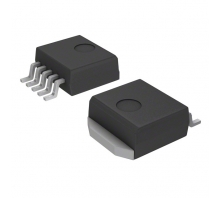
TO-263-6, D2Pak (5 Leads Tab), TO-263BA
Operating Temperature
Operating Temperature is the range of temperatures at which an electronic component can function properly. It is typically specified in degrees Celsius (°C) and indicates the minimum and maximum temperatures at which the component can operate without experiencing damage or degradation. Operating Temperature is an important parameter to consider when designing electronic circuits, as it ensures that the components will function reliably in the intended operating environment.
-40°C~150°C
Series
Series, in the context of electronic components, refers to the arrangement of components in a circuit. When components are connected in series, they form a single path for current to flow through. The total resistance of a series circuit is the sum of the individual resistances of each component. Series connections are often used to control the flow of current in a circuit, as the total resistance can be adjusted by changing the number or type of components in the series.
Automotive, AEC-Q100
Part Status
Part Status is an electronic component parameter that indicates the availability and production status of a component. It is typically used to inform customers about the availability of a component, whether it is in production, end-of-life, or obsolete. Part Status can also provide information about any restrictions or limitations on the component's use, such as whether it is only available for certain applications or if it has been discontinued.
Obsolete
Moisture Sensitivity Level (MSL)
Moisture Sensitivity Level (MSL) is a measure of the susceptibility of a surface mount electronic component to moisture-induced damage during soldering. It is classified into six levels, from 1 (least sensitive) to 6 (most sensitive). MSL is determined by the materials used in the component's construction, including the solderability of its terminals and the presence of moisture-absorbing materials. Components with higher MSL ratings require more stringent handling and storage conditions to prevent moisture absorption and subsequent damage during soldering.
1 (Unlimited)
Terminal Finish
Tin/Lead (Sn80Pb20)
Subcategory
Other Regulators
Technology
Technology, in the context of electronic components, refers to the specific manufacturing process and materials used to create the component. It encompasses the semiconductor fabrication techniques, such as the type of transistor used (e.g., MOSFET, BJT), the gate oxide thickness, and the interconnect materials. Technology also includes the packaging type, such as surface mount or through-hole, and the leadframe or substrate material. The technology used impacts the component's performance characteristics, such as speed, power consumption, and reliability.
BIPOLAR
Peak Reflow Temperature (Cel)
240
Reach Compliance Code
not_compliant
Time@Peak Reflow Temperature-Max (s)
30
Current - Supply (Max)
35mA
Number of Outputs
Number of Outputs refers to the number of independent output signals or channels that an electronic component can provide. It indicates the capability of the component to drive multiple external devices or circuits simultaneously. A higher number of outputs allows for greater flexibility and connectivity in electronic systems.
1
Qualification Status
Not Qualified
Voltage - Input (Max)
45V
Output Voltage
Output Voltage is the voltage level produced by an electronic component when it is operating. It is typically measured in volts (V) and can be either positive or negative. The output voltage of a component is determined by its design and the input voltage applied to it. For example, a voltage regulator will produce a fixed output voltage regardless of the input voltage, while an amplifier will produce an output voltage that is proportional to the input voltage.
3.3V
Output Type
Output type refers to the type of signal or power that an electronic component can produce. It can be analog or digital, AC or DC, and can vary in voltage, current, or power levels. The output type is determined by the component's design and is crucial for matching it with other components in a circuit. Understanding the output type ensures proper signal processing, power delivery, and overall system functionality.
Fixed
Output Configuration
Output Configuration refers to the arrangement of output terminals or pins on an electronic component. It specifies the number, type, and arrangement of these terminals, allowing for various connection options. This parameter is crucial for determining the component's compatibility with other devices and ensuring proper signal flow within a circuit.
Positive
Number of Regulators
Number of Regulators refers to the quantity of voltage regulators present within an electronic component. Voltage regulators are circuits that maintain a constant voltage level, regardless of fluctuations in the input voltage or load current. The number of regulators indicates how many independent voltage regulation circuits are integrated into the component. This parameter is crucial for determining the component's ability to provide stable voltage to multiple circuits or devices.
1
Protection Features
Over Temperature, Reverse Polarity, Short Circuit
Current - Quiescent (Iq)
220μA
Voltage Dropout (Max)
1.332V @ 250mA
Dropout Voltage1-Nom
1.332V
Input Voltage Absolute-Max
45V
Input Bias Current
Input bias current is the small amount of current that flows into the input terminal of an electronic component, such as an operational amplifier or transistor. It is caused by the internal construction of the component and is typically measured in nanoamperes (nA). Input bias current can affect the accuracy of the component's output and must be taken into account when designing circuits.
130μA
Height Seated (Max)
4.826mm
RoHS Status
Non-RoHS Compliant
Description
The NCV4276 is a 400 mA output current integrated low dropout regulator family designed for use in harsh automotive environments. It includes wide operating temperature and input voltage ranges. The device is offered with fixed output voltage options of 1.8 V and 2.5 V with 4% output voltage accuracy while the 3.3 V, 5.0 V, and adjustable voltage versions are available either in 2% or 4% output voltage accuracy. It has a high peak input voltage tolerance and reverse input voltage protection. It also provides overcurrent protection, overtemperature protection, and inhibit for control of the state of the output voltage. The NCV4276 family is available in DPAK and D²PAK surface mount packages. The output is stable over a wide output capacitance and ESR range.
Features
2.5 V and 1.8 V ±4% Output Voltage
3.3 V, 5.0 V, and Adjustable Voltage Version (from 2.5 V to 20 V) 4% or ±2% Output Voltage
400 mA Output Current
500 mV (max) Dropout Voltage (5.0 V Output)
Inhibit Input
Very Low Current Consumption
Fault Protection
45 V Peak Transient Voltage
-42 V Reverse Voltage
Short Circuit
Thermal Overload
NCV Prefix for Automotive and Other Applications Requiring Site and Control Changes
These are Pb-Free Devices
Applications
Automotive
Industrial
Telecommunications
Consumer