Mounting Type
Mounting Type refers to the method by which an electronic component is attached to a printed circuit board (PCB) or other surface. Common mounting types include:
* Through-hole: Component leads are inserted into holes in the PCB and soldered on the other side.
* Surface-mount: Component is placed on the surface of the PCB and soldered in place.
* Press-fit: Component is pressed into place on the PCB without soldering.
* Socket: Component is inserted into a socket on the PCB, allowing for easy replacement.
The mounting type is determined by factors such as the component's size, shape, and power requirements.
Surface Mount
Package / Case
Package / Case refers to the physical housing or enclosure that encapsulates an electronic component. It provides protection, facilitates handling, and enables electrical connections. The package type determines the component's size, shape, pin configuration, and mounting options. Common package types include DIP (dual in-line package), SOIC (small outline integrated circuit), and BGA (ball grid array). The package also influences the component's thermal and electrical performance.
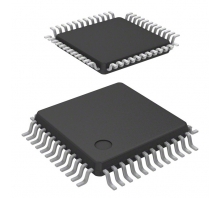
48-TQFP
Packaging
Tape & Reel (TR)
Feature
Internal Oscillator, Timer/Counter
Part Status
Part Status is an electronic component parameter that indicates the availability and production status of a component. It is typically used to inform customers about the availability of a component, whether it is in production, end-of-life, or obsolete. Part Status can also provide information about any restrictions or limitations on the component's use, such as whether it is only available for certain applications or if it has been discontinued.
Discontinued
Moisture Sensitivity Level (MSL)
Moisture Sensitivity Level (MSL) is a measure of the susceptibility of a surface mount electronic component to moisture-induced damage during soldering. It is classified into six levels, from 1 (least sensitive) to 6 (most sensitive). MSL is determined by the materials used in the component's construction, including the solderability of its terminals and the presence of moisture-absorbing materials. Components with higher MSL ratings require more stringent handling and storage conditions to prevent moisture absorption and subsequent damage during soldering.
3 (168 Hours)
Voltage - Supply
2.97V~5.5V
Number of Channels
Number of Channels refers to the number of independent signal paths within an electronic component. It indicates how many separate signals can be processed or transmitted simultaneously. For example, an audio amplifier with two channels can amplify two separate audio signals, while a multi-channel data converter can convert multiple analog signals into digital data. The number of channels is a crucial parameter for determining the component's functionality and application.
1, UART
With False Start Bit Detection
Yes
RoHS Status
RoHS Compliant
Description
The ST16C1450 is a universal asynchronous receiver and transmitter (UART) that is footprint compatible with the SSI 73M1550 and SSI 73M2550 UARTs. It features a one-byte FIFO for both transmission and reception, enhanced UART functions with a modem control interface, and independent programmable baud rate generators with clock rates up to 1.5 Mbps. Onboard status registers provide error indications and operational status, while system interrupts and modem control features can be tailored to specific user requirements. The 1450 also has an internal loop-back capability for on-board diagnostics. It is available in 28-pin PLCC and 48-pin TQFP packages, with the TQFP package offering a buffered reset output that can be controlled through user software. The 1450 is fabricated in an advanced CMOS process for low drain power and high-speed operation.
Features
Pin and functionally compatible with SSI 73M1550/2550
1-byte Transmit FIFO (THR)
1-byte Receive FIFO with error tags (RHR)
Four levels of prioritized interrupts
Modem Control Signals (CTS#, RTS#, DSR#, DTR#, RI#, CD#)
Programmable character lengths (5, 6, 7, 8) with even, odd, or no parity
Crystal or external clock input
1.5 Mbps Transmit/Receive operation (24 MHz) with programmable clock control
Power Down Mode (50 µA at 3.3 V, 200 µA at 5 V)
Software controllable reset output
2.97 to 5.5 Volt operation
Applications
Battery Operated Electronics
Internet Appliances
Handheld Terminals
Personal Digital Assistants
Cellular Phones
DataPort