Mounting Type
Mounting Type refers to the method by which an electronic component is attached to a printed circuit board (PCB) or other surface. Common mounting types include:
* Through-hole: Component leads are inserted into holes in the PCB and soldered on the other side.
* Surface-mount: Component is placed on the surface of the PCB and soldered in place.
* Press-fit: Component is pressed into place on the PCB without soldering.
* Socket: Component is inserted into a socket on the PCB, allowing for easy replacement.
The mounting type is determined by factors such as the component's size, shape, and power requirements.
Surface Mount
Package / Case
Package / Case refers to the physical housing or enclosure that encapsulates an electronic component. It provides protection, facilitates handling, and enables electrical connections. The package type determines the component's size, shape, pin configuration, and mounting options. Common package types include DIP (dual in-line package), SOIC (small outline integrated circuit), and BGA (ball grid array). The package also influences the component's thermal and electrical performance.
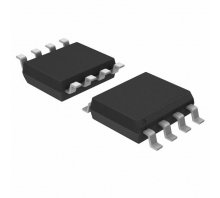
8-SOIC (0.154, 3.90mm Width)
Supplier Device Package
8-SOIC
Operating Temperature
Operating Temperature is the range of temperatures at which an electronic component can function properly. It is typically specified in degrees Celsius (°C) and indicates the minimum and maximum temperatures at which the component can operate without experiencing damage or degradation. Operating Temperature is an important parameter to consider when designing electronic circuits, as it ensures that the components will function reliably in the intended operating environment.
-40°C~150°C TJ
Packaging
Tape & Reel (TR)
Part Status
Part Status is an electronic component parameter that indicates the availability and production status of a component. It is typically used to inform customers about the availability of a component, whether it is in production, end-of-life, or obsolete. Part Status can also provide information about any restrictions or limitations on the component's use, such as whether it is only available for certain applications or if it has been discontinued.
Obsolete
Moisture Sensitivity Level (MSL)
Moisture Sensitivity Level (MSL) is a measure of the susceptibility of a surface mount electronic component to moisture-induced damage during soldering. It is classified into six levels, from 1 (least sensitive) to 6 (most sensitive). MSL is determined by the materials used in the component's construction, including the solderability of its terminals and the presence of moisture-absorbing materials. Components with higher MSL ratings require more stringent handling and storage conditions to prevent moisture absorption and subsequent damage during soldering.
1 (Unlimited)
Voltage - Supply
4.75V~5.25V
Input Type
Input Type refers to the type of signal that an electronic component can accept as input.
Non-Inverting
Channel Type
Channel Type refers to the type of semiconductor material used in the construction of a field-effect transistor (FET). The two main types of channel materials are n-type and p-type. N-type channels are made from materials with an excess of electrons, while p-type channels are made from materials with an excess of holes. The type of channel material determines the polarity of the FET and its operating characteristics.
Single
Driven Configuration
Low-Side
RoHS Status
ROHS3 Compliant
Description
The T5754 is a PLL transmitter IC designed for low-cost transmission systems with data rates up to 32 kBaud. It operates in the frequency range of 429 MHz to 439 MHz and can be used in both FSK and ASK systems. The IC features excellent isolation between the PLL, PA, and power supply, making it easy to design in. It requires minimal external circuitry and can be powered by a single Li-cell. The T5754 is available in a TSSOP8L package and can operate at temperatures up to 125°C, making it suitable for tire pressure systems.
Features
Integrated PLL loop filter
ESD protection at ANT1/ANT2 (4 kV HBM/200V MM; except Pin 2: 4 kV HBM/100V MM)
High output power (7.5 dBm) with low supply current (9.0 mA)
ASK/FSK modulation
FSK modulation achieved by connecting an additional capacitor between the XTAL load capacitor and the open drain output of the modulating microcontroller
Excellent isolation of the PLL from the PA and power supply
Single Li-cell power supply
Supply voltage: 2.0V to 4.0V in the temperature range of -40°C to 85°C/125°C
Single-ended antenna output with high efficient power amplifier
CLK output for clocking the microcontroller
One-chip solution with minimum external circuitry
125°C operation for tire pressure systems
Applications
Remote control systems
Tire pressure monitoring systems
Wireless sensors
Low-cost data transmission systems