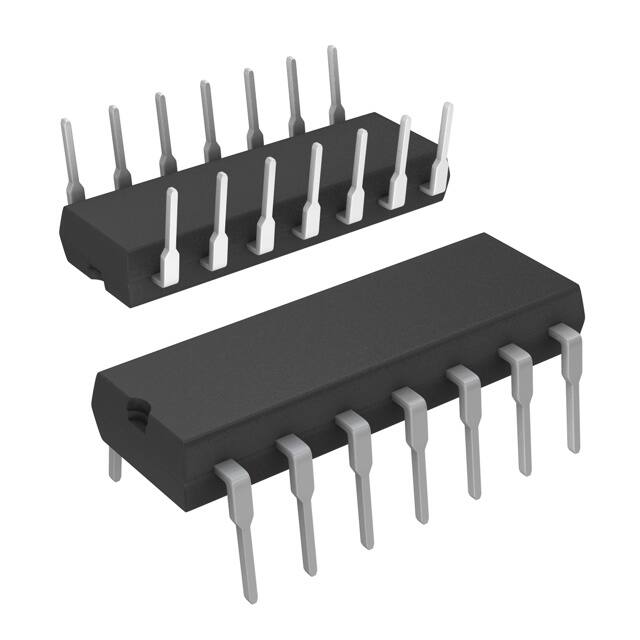
Mounting Type
Mounting Type refers to the method by which an electronic component is attached to a printed circuit board (PCB) or other surface. Common mounting types include:
* Through-hole: Component leads are inserted into holes in the PCB and soldered on the other side.
* Surface-mount: Component is placed on the surface of the PCB and soldered in place.
* Press-fit: Component is pressed into place on the PCB without soldering.
* Socket: Component is inserted into a socket on the PCB, allowing for easy replacement.
The mounting type is determined by factors such as the component's size, shape, and power requirements.
Through Hole
Package / Case
Package / Case refers to the physical housing or enclosure that encapsulates an electronic component. It provides protection, facilitates handling, and enables electrical connections. The package type determines the component's size, shape, pin configuration, and mounting options. Common package types include DIP (dual in-line package), SOIC (small outline integrated circuit), and BGA (ball grid array). The package also influences the component's thermal and electrical performance.
14-DIP (0.300, 7.62mm)
Supplier Device Package
14-DIP
Operating Temperature
Operating Temperature is the range of temperatures at which an electronic component can function properly. It is typically specified in degrees Celsius (°C) and indicates the minimum and maximum temperatures at which the component can operate without experiencing damage or degradation. Operating Temperature is an important parameter to consider when designing electronic circuits, as it ensures that the components will function reliably in the intended operating environment.
-40°C~85°C
Series
Series, in the context of electronic components, refers to the arrangement of components in a circuit. When components are connected in series, they form a single path for current to flow through. The total resistance of a series circuit is the sum of the individual resistances of each component. Series connections are often used to control the flow of current in a circuit, as the total resistance can be adjusted by changing the number or type of components in the series.
74ABT
Part Status
Part Status is an electronic component parameter that indicates the availability and production status of a component. It is typically used to inform customers about the availability of a component, whether it is in production, end-of-life, or obsolete. Part Status can also provide information about any restrictions or limitations on the component's use, such as whether it is only available for certain applications or if it has been discontinued.
Obsolete
Moisture Sensitivity Level (MSL)
Moisture Sensitivity Level (MSL) is a measure of the susceptibility of a surface mount electronic component to moisture-induced damage during soldering. It is classified into six levels, from 1 (least sensitive) to 6 (most sensitive). MSL is determined by the materials used in the component's construction, including the solderability of its terminals and the presence of moisture-absorbing materials. Components with higher MSL ratings require more stringent handling and storage conditions to prevent moisture absorption and subsequent damage during soldering.
3 (168 Hours)
Voltage - Supply
4.5V~5.5V
Number of Circuits
Number of Circuits refers to the number of independent signal paths within an electronic component. It indicates how many separate circuits or channels the component can handle simultaneously. For example, an operational amplifier with a Number of Circuits of 2 can amplify two separate input signals independently. This parameter is crucial for determining the component's functionality and its suitability for specific applications.
4
Number of Inputs
The number of inputs of an electronic component refers to the number of separate signals or data streams that the component can receive and process simultaneously. It indicates the maximum number of external connections that can be made to the component to provide input signals. This parameter is crucial for determining the functionality and connectivity of the component within a circuit or system.
2
Current - Output High, Low
15mA 20mA
Logic Type
Logic Type refers to the type of logic implemented by an electronic component, such as a logic gate or flip-flop.
AND Gate
Max Propagation Delay @ V, Max CL
3.4ns @ 5V, 50pF
Logic Level - High
Logic Level - High refers to the voltage level that represents a logical "1" in a digital circuit. It is typically defined as a voltage range that is higher than a specified threshold voltage. The specific value of the Logic Level - High depends on the logic family being used, such as TTL, CMOS, or ECL. For example, in TTL logic, the Logic Level - High is typically defined as a voltage between 2.4V and 5V.
2V
Current - Quiescent (Max)
50μA
RoHS Status
ROHS3 Compliant
74ABT08N,112 Overview
Due to its 14-DIP (0.300, 7.62mm) packaging, the part is convenient for international shipping. High reliability is achieved by using advanced packaging method Tube. AND Gate logic is the basis of its operation. This part needs a voltage of 4.5V~5.5V to function properly. An extended operating temperature of -40°C~85°C degrees Celsius. Part Through Hole is mounted. High and low output current states are both 15mA 20mA. The series 74ABT contains it. It supports inputs of 2. A 4 circuit is present in this device. 50μA is the maximum current in standby mode. Suppliers offer a package of 14-DIP.
74ABT08N,112 Features
AND Gate Logic Type
Operating Temperature: -40°C~85°C
74ABT08N,112 Applications
There are a lot of Rochester Electronics, LLC
74ABT08N,112 Gates and Inverters applications.
Sewing machine
DVD
VCD
Computer
Television
Washing machine
Range hood
Refrigerator
VCR
Massager
74ABT08N,112 More Descriptions
Abt Series Quad 2-INPUT And Gate PDIP14
AND Gate 4-Element 2-IN 14-Pin PDIP Bulk/Tube
AND Gate Through Hole ROHS3Compliant Not Qualified AND Gate Inverter IC 50pF -40C~85C 5.5V 15mA 20mA
AND GATE, ABT SERIES, 4 FUNC, 2-