Mounting Type
Mounting Type refers to the method by which an electronic component is attached to a printed circuit board (PCB) or other surface. Common mounting types include:
* Through-hole: Component leads are inserted into holes in the PCB and soldered on the other side.
* Surface-mount: Component is placed on the surface of the PCB and soldered in place.
* Press-fit: Component is pressed into place on the PCB without soldering.
* Socket: Component is inserted into a socket on the PCB, allowing for easy replacement.
The mounting type is determined by factors such as the component's size, shape, and power requirements.
Surface Mount
Package / Case
Package / Case refers to the physical housing or enclosure that encapsulates an electronic component. It provides protection, facilitates handling, and enables electrical connections. The package type determines the component's size, shape, pin configuration, and mounting options. Common package types include DIP (dual in-line package), SOIC (small outline integrated circuit), and BGA (ball grid array). The package also influences the component's thermal and electrical performance.
10-CLCC
Operating Temperature
Operating Temperature is the range of temperatures at which an electronic component can function properly. It is typically specified in degrees Celsius (°C) and indicates the minimum and maximum temperatures at which the component can operate without experiencing damage or degradation. Operating Temperature is an important parameter to consider when designing electronic circuits, as it ensures that the components will function reliably in the intended operating environment.
-40°C~85°C
Series
Series, in the context of electronic components, refers to the arrangement of components in a circuit. When components are connected in series, they form a single path for current to flow through. The total resistance of a series circuit is the sum of the individual resistances of each component. Series connections are often used to control the flow of current in a circuit, as the total resistance can be adjusted by changing the number or type of components in the series.
FemtoClock® NG
Part Status
Part Status is an electronic component parameter that indicates the availability and production status of a component. It is typically used to inform customers about the availability of a component, whether it is in production, end-of-life, or obsolete. Part Status can also provide information about any restrictions or limitations on the component's use, such as whether it is only available for certain applications or if it has been discontinued.
Active
Moisture Sensitivity Level (MSL)
Moisture Sensitivity Level (MSL) is a measure of the susceptibility of a surface mount electronic component to moisture-induced damage during soldering. It is classified into six levels, from 1 (least sensitive) to 6 (most sensitive). MSL is determined by the materials used in the component's construction, including the solderability of its terminals and the presence of moisture-absorbing materials. Components with higher MSL ratings require more stringent handling and storage conditions to prevent moisture absorption and subsequent damage during soldering.
1 (Unlimited)
Voltage - Supply
2.375V~2.625V
Frequency
Frequency, in the context of electronic components, refers to the rate at which an alternating current or voltage changes direction per second. It is measured in Hertz (Hz), which represents one cycle per second. Frequency is a crucial parameter for various electronic components, such as capacitors, inductors, and resonators. It determines the component's ability to store or release energy, filter signals, and resonate at specific frequencies. Understanding the frequency characteristics of electronic components is essential for designing and optimizing electronic circuits.
156.25MHz 100MHz 125MHz 312.5MHz
RoHS Status
Non-RoHS Compliant
Description
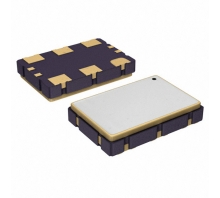
The IDT8N3Q001 is a Quad-Frequency Programmable Clock Oscillator with flexible frequency programming capabilities. It utilizes FemtoClock® NG technology for optimal clock frequency and low phase noise performance. The device accepts 2.5V or 3.3V supply and is packaged in a lead-free 10-lead Ceramic 5mm x 7mm x 1.55mm package.
Features
Fourth generation FemtoClock® NG technology
Programmable clock output frequency from 15.476MHz to 866.67MHz and from 975MHz to 1,300MHz
Four power-up default frequencies, re-programmable by IC
PC interface for programming output clock frequency and internal PLL control registers
Frequency programming resolution of 435.9Hz N
One 2.5V, 3.3V LVPECL clock output
Two control inputs for power-up default frequency
LVCMOS/LVTTL compatible control inputs
RMS phase jitter @156.25MHz (12kHz-20MHz): 0.244ps (typical), integer PLL feedback configuration
RMS phase jitter @156.25MHz (1kHz - 40MHz): 0.265ps (typical), integer PLL feedback configuration
Full 2.5V or 3.3V supply modes
-40°C to 85°C ambient operating temperature
Available in Lead-free (RoHS 6) package
Applications
Wireless infrastructure
Telecommunication
Networking end equipment