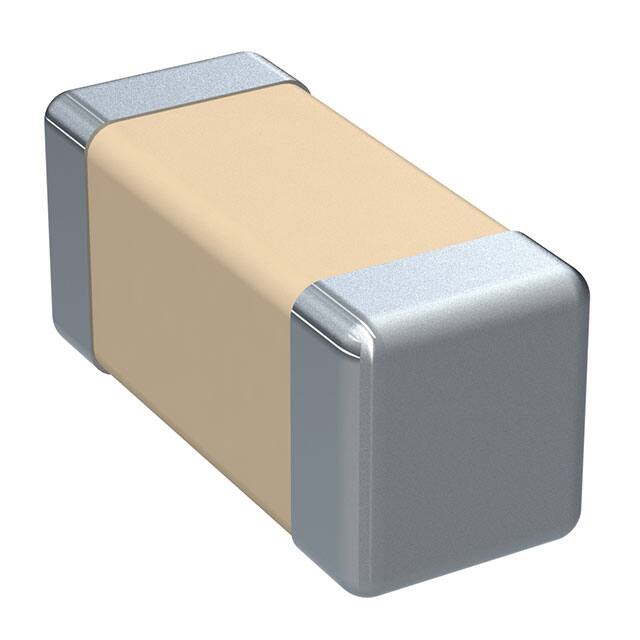
Factory Lead Time
52 Weeks
Mounting Type
Mounting Type refers to the method by which an electronic component is attached to a printed circuit board (PCB) or other surface. Common mounting types include:
* Through-hole: Component leads are inserted into holes in the PCB and soldered on the other side.
* Surface-mount: Component is placed on the surface of the PCB and soldered in place.
* Press-fit: Component is pressed into place on the PCB without soldering.
* Socket: Component is inserted into a socket on the PCB, allowing for easy replacement.
The mounting type is determined by factors such as the component's size, shape, and power requirements.
Surface Mount, MLCC
Package / Case
Package / Case refers to the physical housing or enclosure that encapsulates an electronic component. It provides protection, facilitates handling, and enables electrical connections. The package type determines the component's size, shape, pin configuration, and mounting options. Common package types include DIP (dual in-line package), SOIC (small outline integrated circuit), and BGA (ball grid array). The package also influences the component's thermal and electrical performance.
0603 (1608 Metric)
Material
In electronic components, "Material" refers to the substance or composition used to construct the component. It determines the electrical, mechanical, and thermal properties of the component.
Ceramic
Operating Temperature
Operating Temperature is the range of temperatures at which an electronic component can function properly. It is typically specified in degrees Celsius (°C) and indicates the minimum and maximum temperatures at which the component can operate without experiencing damage or degradation. Operating Temperature is an important parameter to consider when designing electronic circuits, as it ensures that the components will function reliably in the intended operating environment.
-55°C~125°C
Packaging
Tape & Reel (TR)
Series
Series, in the context of electronic components, refers to the arrangement of components in a circuit. When components are connected in series, they form a single path for current to flow through. The total resistance of a series circuit is the sum of the individual resistances of each component. Series connections are often used to control the flow of current in a circuit, as the total resistance can be adjusted by changing the number or type of components in the series.
SMD Auto U2J
Size / Dimension
0.063Lx0.031W 1.60mmx0.80mm
Tolerance
Tolerance in electronic components refers to the allowable deviation from the specified value. It indicates the range within which the actual value of the component can vary while still meeting the manufacturer's specifications. Tolerance is typically expressed as a percentage of the nominal value, such as ±5% or ±10%. A lower tolerance indicates a tighter range of acceptable values, resulting in more precise and consistent performance.
±10%
Feature
Low ESL, Low Dissipation Factor
Part Status
Part Status is an electronic component parameter that indicates the availability and production status of a component. It is typically used to inform customers about the availability of a component, whether it is in production, end-of-life, or obsolete. Part Status can also provide information about any restrictions or limitations on the component's use, such as whether it is only available for certain applications or if it has been discontinued.
Active
Moisture Sensitivity Level (MSL)
Moisture Sensitivity Level (MSL) is a measure of the susceptibility of a surface mount electronic component to moisture-induced damage during soldering. It is classified into six levels, from 1 (least sensitive) to 6 (most sensitive). MSL is determined by the materials used in the component's construction, including the solderability of its terminals and the presence of moisture-absorbing materials. Components with higher MSL ratings require more stringent handling and storage conditions to prevent moisture absorption and subsequent damage during soldering.
1 (Unlimited)
Temperature Coefficient
Temperature Coefficient (TC) measures the relative change in a component's value due to temperature variations. It is expressed as a percentage change per degree Celsius (°C). A positive TC indicates an increase in value with increasing temperature, while a negative TC indicates a decrease. TC is crucial for ensuring stable circuit performance over a range of temperatures. It helps designers compensate for temperature-induced changes and maintain desired component characteristics.
U2J
Voltage - Rated
Voltage - Rated refers to the maximum voltage that an electronic component can withstand without being damaged. It is typically specified in volts (V) and is an important parameter to consider when selecting components for a circuit. Exceeding the rated voltage can lead to component failure, so it is important to ensure that the voltage applied to a component does not exceed its rated voltage.
16V
Capacitance
Capacitance is the ability of a component to store electrical charge. It is measured in farads (F). A capacitor is a passive electronic component that consists of two conductors separated by an insulator. When a voltage is applied across the capacitor, charge builds up on the conductors. The amount of charge that can be stored depends on the capacitance of the capacitor. Capacitors are used in a variety of electronic circuits, including filters, timing circuits, and energy storage devices.
2200pF
Height
Height, in the context of electronic components, refers to the vertical dimension of the component. It is typically measured in millimeters (mm) or inches (in). Height is an important parameter to consider when designing and assembling electronic circuits, as it affects the overall size and form factor of the device. Components with a smaller height are often preferred for applications where space is limited, such as in portable devices or embedded systems.
870μm
Thickness (Max)
0.034 0.87mm
RoHS Status
ROHS3 Compliant
C0603C222K4JACAUTO Overview
This device's program size/dimension is 0.063Lx0.031W 1.60mmx0.80mm.A substance's temperature coefficient of resistance is generally defined as how its electrical resistance changes with per degree change in temperature.
C0603C222K4JACAUTO Features
a size/dimension of 0.063Lx0.031W 1.60mmx0.80mm
with U2J being the highest temperature coefficient
C0603C222K4JACAUTO Applications
There are a lot of KEMET
C0603C222K4JACAUTO applications of ceramic capacitors.
General electronic equipment
Mobile devices
Servers, PCs, tablets
Power supply circuit
C0603C222K4JACAUTO More Descriptions
Cap Cer 0603 2.2nF 16V U2J /-10% AUTO | KEMET C0603C222K4JACAUTO
CAP CER 2200PF 16V U2J 0603