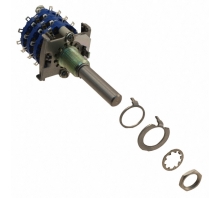
Electroswitch D2D0312N

Mfr.Part #:

D2D0312N

Manufacturer:

Description:
SWITCH ROTARY 2-12POS 250MA 115V

RoHS Status:

RoHS

Datasheet:

Payment:

Payment

Delivery:

Delivery

Quick Request Quote

Do you want a lower wholesale price? Please send us an inquiry, and we will respond immediately.

Latest Posts

A switch solenoid converts electrical energy into mechanical movement by using a simple principle:...
Voltage controlled oscillator takes a voltage (like from a battery) and turns it into...
Types of computer cables: USB cables, HDMI cables, Ethernet cables, power cables,VGA and display
A potentiometer is like a dimmer switch for electronic devices - it controls the...
Security

Buy With Confidence

ISO 9001
ISO 9001
ISO 45001
ISO 45001
ISO 13485
ISO 13485
ISO 14001
ISO 14001
SMTA
ASA

Specifications

Product Details

Product Comparison

Factory Lead Time
6 Weeks
Contact Material

Contact Material refers to the material used to make the electrical contacts in a component. It determines the electrical conductivity, durability, and resistance to corrosion and wear of the contacts. Common contact materials include copper, silver, gold, and alloys of these metals. The choice of contact material depends on the specific application and the required performance characteristics.

Brass
Contact Plating
Silver
Mount
Panel
Mounting Type

Mounting Type refers to the method by which an electronic component is attached to a printed circuit board (PCB) or other surface. Common mounting types include: * Through-hole: Component leads are inserted into holes in the PCB and soldered on the other side. * Surface-mount: Component is placed on the surface of the PCB and soldered in place. * Press-fit: Component is pressed into place on the PCB without soldering. * Socket: Component is inserted into a socket on the PCB, allowing for easy replacement. The mounting type is determined by factors such as the component's size, shape, and power requirements.

Panel Mount
Series

Series, in the context of electronic components, refers to the arrangement of components in a circuit. When components are connected in series, they form a single path for current to flow through. The total resistance of a series circuit is the sum of the individual resistances of each component. Series connections are often used to control the flow of current in a circuit, as the total resistance can be adjusted by changing the number or type of components in the series.

D2
Published
2006
Part Status

Part Status is an electronic component parameter that indicates the availability and production status of a component. It is typically used to inform customers about the availability of a component, whether it is in production, end-of-life, or obsolete. Part Status can also provide information about any restrictions or limitations on the component's use, such as whether it is only available for certain applications or if it has been discontinued.

Active
Moisture Sensitivity Level (MSL)

Moisture Sensitivity Level (MSL) is a measure of the susceptibility of a surface mount electronic component to moisture-induced damage during soldering. It is classified into six levels, from 1 (least sensitive) to 6 (most sensitive). MSL is determined by the materials used in the component's construction, including the solderability of its terminals and the presence of moisture-absorbing materials. Components with higher MSL ratings require more stringent handling and storage conditions to prevent moisture absorption and subsequent damage during soldering.

Not Applicable
Termination

Termination refers to the electrical characteristics of a component or circuit at its input or output terminals. It describes how the component or circuit interacts with external signals or devices. Termination can involve matching impedance, providing voltage or current regulation, or filtering unwanted signals. Proper termination ensures efficient signal transfer, minimizes reflections, and prevents damage to components. It is crucial for maintaining signal integrity and optimizing circuit performance.

Solder
Number of Positions

Number of Positions, in the context of electronic components, refers to the number of distinct terminals or connection points available on the component. It indicates the number of individual electrical connections that can be made to the component. A higher number of positions typically allows for more complex functionality and versatility in circuit design.

2 ~ 12
Voltage - Rated DC
28V
Current Rating (Amps)
250mA AC 550mA DC
Orientation

Orientation refers to the physical alignment or position of an electronic component in relation to a reference point or axis. It specifies the direction in which the component should be mounted or installed to ensure proper functionality and performance. Orientation is crucial for components such as diodes, transistors, capacitors, and connectors, where the polarity or pinout must be correctly aligned to prevent damage or malfunction.

Straight
Depth
24.6888mm
Current Rating

Current Rating is the maximum amount of current that an electronic component can safely handle without overheating or failing. It is typically expressed in amperes (A) or milliamperes (mA). Exceeding the current rating can damage the component and potentially create a safety hazard. The current rating is determined by the physical characteristics of the component, such as its size, material, and construction.

550mA
Contact Finish
Silver
Termination Style

Termination Style refers to the method used to connect an electronic component to a circuit board or other components. It describes the physical form and electrical characteristics of the connection point. Common termination styles include through-hole, surface mount, and press-fit. Through-hole components have leads that are inserted into holes on the circuit board and soldered in place. Surface mount components are soldered directly onto the surface of the circuit board. Press-fit components are inserted into holes on the circuit board and held in place by friction.

Solder Lug
Voltage - Rated AC
115V
Actuator Type

Actuator Type refers to the type of mechanism used in an actuator to convert electrical signals into physical movement.

Round (6.35mm Dia)
Panel Cutout Dimensions
Circular - 9.78mm Dia
Contact Style
Non-Shorting
Contact Resistance

Contact resistance is the electrical resistance between two electrical contacts. It is caused by the imperfect contact between the two surfaces, which results in a small amount of resistance to the flow of current. Contact resistance can be a significant factor in the performance of electrical circuits, especially in high-power applications. It can cause power loss, heating, and even damage to components.

5mOhm
Max Voltage Rating (AC)
115V
Number of Poles

The number of poles in an electronic component, such as an inductor or capacitor, refers to the number of pairs of magnetic or electric field lines that pass through the component's core. A higher number of poles generally indicates a stronger magnetic or electric field and, consequently, a higher inductance or capacitance. The number of poles is a crucial parameter in determining the component's performance and suitability for specific applications.

1
Throw Configuration
3P12T, SP12T
Max Voltage Rating (DC)
28V
Mechanical Life

Mechanical Life refers to the number of times a switch or relay can be operated before it fails mechanically. It is typically measured in millions of cycles and is an important consideration for applications where the switch or relay will be subjected to frequent use. A high mechanical life indicates that the switch or relay is durable and will be able to withstand repeated use without failing.

25000 cycles
Number of Decks
3
Contact Timing
Non-Shorting (BBM)
Index Stops
Adjustable
Circuit per Deck
SP12T
Depth Behind Panel
24.69mm
Index Angle
30 °
Number of Poles per Deck
1
Angle of Throw
30°
Actuator Length
25.40mm
REACH SVHC
Unknown
RoHS Status
RoHS Compliant
Lead Free
Lead Free
D2D0312N Overview
This product is manufactured by Electroswitch and belongs to the category of Rotary Switches. The images we provide are for reference only, for detailed product information please see specification sheet D2D0312N or the datasheet in PDF format. As a professional electronic components distributor, Zeano has five million electronic components available. Additionally, we have over 500,000 electronic components in stock ready for immediate shipment. If you have requirements, you can send us a quotation form to get the price of D2D0312N. We attach great importance to our customers' purchasing experience and are willing to establish a long-term cooperative relationship with you. If you have any questions or requirements, please feel free to contact us.
D2D0312N More Descriptions
Switch, Rotary, 3P12T, 3 Poles, 12 Positions, 30 Angle of Throw | Electroswitch Inc. D2D0312N
Switch Rotary 3P 12 Shaft Solder Lug 0.55A 115VAC 28VDC
Rotary Switches ROTARY SWITCH 3 POLE 550mA
SWITCH, ROTARY, 3P12T, 550mA, 115V; No.; SWITCH, ROTARY, 3P12T, 550mA, 115V; No. of Poles:3; No. of Switch Positions:12; Angle of Throw:30°; Contact Current AC Max:250mA; Contact Current DC Max:550mA; Contact Voltage AC Max:115V; Contact Voltage DC Max:28V; Circuitry:SPDT
No Product Comparison

Recommended Offers

Texas Instruments
LM4051CIM3-ADJ/NOPB
Fairchild/ON Semiconductor
KA431SAMF2TF
Active-Semi International Inc.
ACT8810QJ3EB-T
Maxim Integrated
MAX1765EUE
Analog Devices Inc.
AD5170BRM10-RL7
Texas Instruments
TPS65233RTER
Maxim Integrated
DS1867E-050+T&R
STMicroelectronics
STOD03BTPUR
Linear Technology
LTC4367CDD#TRPBF
STMicroelectronics
STLUX325ATR
Maxim Integrated
MAX8667ETEAC+T
Rohm Semiconductor
BD8151EFV-E2