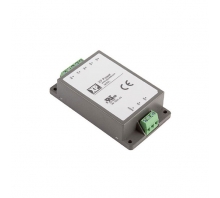
Factory Lead Time
3 Weeks
Mounting Type
Mounting Type refers to the method by which an electronic component is attached to a printed circuit board (PCB) or other surface. Common mounting types include:
* Through-hole: Component leads are inserted into holes in the PCB and soldered on the other side.
* Surface-mount: Component is placed on the surface of the PCB and soldered in place.
* Press-fit: Component is pressed into place on the PCB without soldering.
* Socket: Component is inserted into a socket on the PCB, allowing for easy replacement.
The mounting type is determined by factors such as the component's size, shape, and power requirements.
DIN Rail
Package / Case
Package / Case refers to the physical housing or enclosure that encapsulates an electronic component. It provides protection, facilitates handling, and enables electrical connections. The package type determines the component's size, shape, pin configuration, and mounting options. Common package types include DIP (dual in-line package), SOIC (small outline integrated circuit), and BGA (ball grid array). The package also influences the component's thermal and electrical performance.
Module
Operating Temperature
Operating Temperature is the range of temperatures at which an electronic component can function properly. It is typically specified in degrees Celsius (°C) and indicates the minimum and maximum temperatures at which the component can operate without experiencing damage or degradation. Operating Temperature is an important parameter to consider when designing electronic circuits, as it ensures that the components will function reliably in the intended operating environment.
-40°C~85°C
Series
Series, in the context of electronic components, refers to the arrangement of components in a circuit. When components are connected in series, they form a single path for current to flow through. The total resistance of a series circuit is the sum of the individual resistances of each component. Series connections are often used to control the flow of current in a circuit, as the total resistance can be adjusted by changing the number or type of components in the series.
DTE20 (20W)
Size / Dimension
3.78Lx2.13W x 0.92 H 96.0mmx54.0mmx23.3mm
Part Status
Part Status is an electronic component parameter that indicates the availability and production status of a component. It is typically used to inform customers about the availability of a component, whether it is in production, end-of-life, or obsolete. Part Status can also provide information about any restrictions or limitations on the component's use, such as whether it is only available for certain applications or if it has been discontinued.
Active
Moisture Sensitivity Level (MSL)
Moisture Sensitivity Level (MSL) is a measure of the susceptibility of a surface mount electronic component to moisture-induced damage during soldering. It is classified into six levels, from 1 (least sensitive) to 6 (most sensitive). MSL is determined by the materials used in the component's construction, including the solderability of its terminals and the presence of moisture-absorbing materials. Components with higher MSL ratings require more stringent handling and storage conditions to prevent moisture absorption and subsequent damage during soldering.
Not Applicable
Applications
ITE (Commercial)
Max Power Dissipation
20W
Number of Outputs
Number of Outputs refers to the number of independent output signals or channels that an electronic component can provide. It indicates the capability of the component to drive multiple external devices or circuits simultaneously. A higher number of outputs allows for greater flexibility and connectivity in electronic systems.
1
Approval Agency
CB, CE, cURus
Voltage - Input (Max)
36V
Output Power
Output Power is a measure of the electrical power delivered by an electronic component to a load. It is typically expressed in watts (W) or milliwatts (mW). The output power of a component is determined by its design and the voltage and current applied to it.
Output power is an important parameter for many electronic components, such as amplifiers, power supplies, and transmitters. It is used to determine the component's efficiency and to ensure that it can provide enough power to drive the load.
20W
Height
Height, in the context of electronic components, refers to the vertical dimension of the component. It is typically measured in millimeters (mm) or inches (in). Height is an important parameter to consider when designing and assembling electronic circuits, as it affects the overall size and form factor of the device. Components with a smaller height are often preferred for applications where space is limited, such as in portable devices or embedded systems.
23.368mm
RoHS Status
ROHS3 Compliant
The XP Power DTE2024S5V1-D is a 20W DC/DC converter that provides a regulated 5.1V output from a wide 4:1 input voltage range of 9-36V DC. It is housed in a single-in-line package (SIP) for easy integration into a variety of applications. This converter is designed to provide high efficiency and low noise operation, making it ideal for use in a wide range of applications.
Features:
- 4:1 input voltage range of 9-36V DC
- Output voltage of 5.1V
- Output power of 20W
- High efficiency and low noise operation
- Single-in-line package (SIP) for easy integration
- Over-temperature, over-current, and short-circuit protection
Applications:
- Industrial automation
- Telecommunications
- Automotive
- Medical equipment
- Test and measurement equipment
- Power supplies
- LED lighting
DTE2024S5V1-D More Descriptions
DC-DC Converter 20W 4:1 DIN RAIL MT | XP Power DTE2024S5V1-D
Dc-Dc Converter, 5.1V, 4A; Power Supply Applications:Ite; Input Ratio:4:1; Output Power Max:20W; No. Of Outputs:1 Output; Output Voltage - Output 1:5.1V; Output Current - Output 1:4A; Output Voltage - Output 2:-; Width:54Mm Rohs Compliant: Yes |Xp Power DTE2024S5V1-D
DC/DC DIN RAIL SUPPLY 5.1V 20W