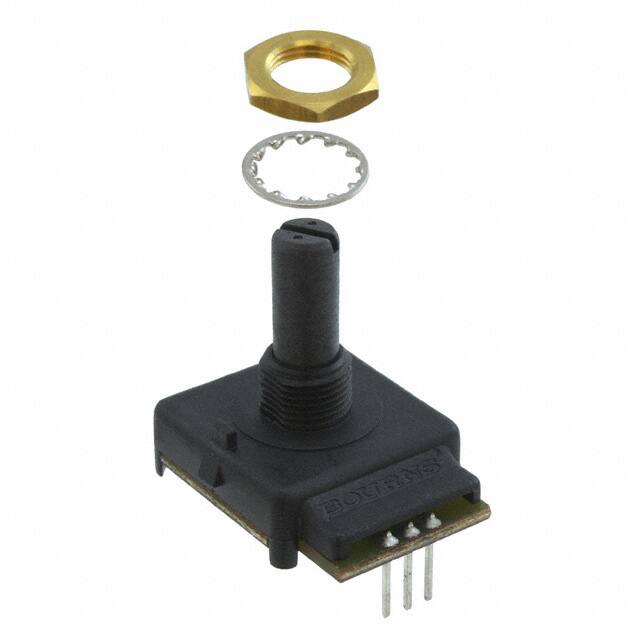
Factory Lead Time
6 Weeks
Mount
Brackets, PCB, Panel, Through Hole
Mounting Type
Mounting Type refers to the method by which an electronic component is attached to a printed circuit board (PCB) or other surface. Common mounting types include:
* Through-hole: Component leads are inserted into holes in the PCB and soldered on the other side.
* Surface-mount: Component is placed on the surface of the PCB and soldered in place.
* Press-fit: Component is pressed into place on the PCB without soldering.
* Socket: Component is inserted into a socket on the PCB, allowing for easy replacement.
The mounting type is determined by factors such as the component's size, shape, and power requirements.
Panel, PCB Through Hole
Series
Series, in the context of electronic components, refers to the arrangement of components in a circuit. When components are connected in series, they form a single path for current to flow through. The total resistance of a series circuit is the sum of the individual resistances of each component. Series connections are often used to control the flow of current in a circuit, as the total resistance can be adjusted by changing the number or type of components in the series.
ECW
Part Status
Part Status is an electronic component parameter that indicates the availability and production status of a component. It is typically used to inform customers about the availability of a component, whether it is in production, end-of-life, or obsolete. Part Status can also provide information about any restrictions or limitations on the component's use, such as whether it is only available for certain applications or if it has been discontinued.
Active
Moisture Sensitivity Level (MSL)
Moisture Sensitivity Level (MSL) is a measure of the susceptibility of a surface mount electronic component to moisture-induced damage during soldering. It is classified into six levels, from 1 (least sensitive) to 6 (most sensitive). MSL is determined by the materials used in the component's construction, including the solderability of its terminals and the presence of moisture-absorbing materials. Components with higher MSL ratings require more stringent handling and storage conditions to prevent moisture absorption and subsequent damage during soldering.
1 (Unlimited)
Termination
Termination refers to the electrical characteristics of a component or circuit at its input or output terminals. It describes how the component or circuit interacts with external signals or devices. Termination can involve matching impedance, providing voltage or current regulation, or filtering unwanted signals. Proper termination ensures efficient signal transfer, minimizes reflections, and prevents damage to components. It is crucial for maintaining signal integrity and optimizing circuit performance.
PC Pins
Max Operating Temperature
85°C
Min Operating Temperature
-40°C
Orientation
Orientation refers to the physical alignment or position of an electronic component in relation to a reference point or axis. It specifies the direction in which the component should be mounted or installed to ensure proper functionality and performance. Orientation is crucial for components such as diodes, transistors, capacitors, and connectors, where the polarity or pinout must be correctly aligned to prevent damage or malfunction.
Vertical
Termination Style
Termination Style refers to the method used to connect an electronic component to a circuit board or other components. It describes the physical form and electrical characteristics of the connection point. Common termination styles include through-hole, surface mount, and press-fit. Through-hole components have leads that are inserted into holes on the circuit board and soldered in place. Surface mount components are soldered directly onto the surface of the circuit board. Press-fit components are inserted into holes on the circuit board and held in place by friction.
PC Pin
Actuator Type
Actuator Type refers to the type of mechanism used in an actuator to convert electrical signals into physical movement.
1/4 Dia Flatted End
Output Type
Output type refers to the type of signal or power that an electronic component can produce. It can be analog or digital, AC or DC, and can vary in voltage, current, or power levels. The output type is determined by the component's design and is crucial for matching it with other components in a circuit. Understanding the output type ensures proper signal processing, power delivery, and overall system functionality.
Quadrature (Incremental)
Number of Channels
Number of Channels refers to the number of independent signal paths within an electronic component. It indicates how many separate signals can be processed or transmitted simultaneously. For example, an audio amplifier with two channels can amplify two separate audio signals, while a multi-channel data converter can convert multiple analog signals into digital data. The number of channels is a crucial parameter for determining the component's functionality and application.
2
Optoelectronic Device Type
ROTARY POSITION ENCODER
Pulses per Revolution
Pulses Per Revolution (PPR) is a parameter that specifies the number of electrical pulses generated by an encoder for each complete revolution of its shaft. It is a measure of the encoder's resolution, as a higher PPR indicates a more precise measurement of the shaft's rotation. PPR is commonly used in applications such as motor control, robotics, and measurement systems, where accurate and reliable rotational information is crucial.
6
Rotational Life (Cycles Min)
200K
Nominal Supply Voltage (DC)
10V
RoHS Status
ROHS3 Compliant
ECW0D-C24-BC0006L Overview
It is essential that the minimum operating temperature of the encoder does not fall below -40°C. There is however a maximum operating temperature of 85°C for this electronic part. Encoders are packaged as Bulk. There is 10V voltage level for the encoder in the electrical power system.
ECW0D-C24-BC0006L Features
Series: ECW
Termination: PC Pins
ECW0D-C24-BC0006L Applications
There are a lot of Bourns Inc.
ECW0D-C24-BC0006L Encoders applications.
Tape drives
Factory automation equipment
Global Positioning/Driver Information Systems
Medical Equipment
Automatic health monitoring systems
RF-based home automation system
Robotics vehicle with the metal detector
War field flying robot with a using night-vision flying camera
Speed synchronization of multiple motors in industries
Encoder for CNC machines
ECW0D-C24-BC0006L More Descriptions
Encoder-Digital Contacting Rohs Compliant: Yes |Bourns ECW0D-C24-BC0006L
Mechanical Encoder Rotary Incremental Flat 2.25oz-in Straight Gray Digital Square Wave Solder Pin
Encoders DIGITAL CONTACTING ENCODER
ROTARY ENCODER MECHANICAL 6PPR