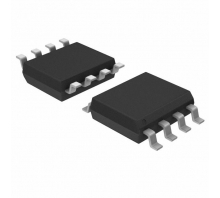
Mounting Type
Mounting Type refers to the method by which an electronic component is attached to a printed circuit board (PCB) or other surface. Common mounting types include:
* Through-hole: Component leads are inserted into holes in the PCB and soldered on the other side.
* Surface-mount: Component is placed on the surface of the PCB and soldered in place.
* Press-fit: Component is pressed into place on the PCB without soldering.
* Socket: Component is inserted into a socket on the PCB, allowing for easy replacement.
The mounting type is determined by factors such as the component's size, shape, and power requirements.
Surface Mount
Package / Case
Package / Case refers to the physical housing or enclosure that encapsulates an electronic component. It provides protection, facilitates handling, and enables electrical connections. The package type determines the component's size, shape, pin configuration, and mounting options. Common package types include DIP (dual in-line package), SOIC (small outline integrated circuit), and BGA (ball grid array). The package also influences the component's thermal and electrical performance.
8-SOIC (0.154, 3.90mm Width)
Packaging
Tape & Reel (TR)
Series
Series, in the context of electronic components, refers to the arrangement of components in a circuit. When components are connected in series, they form a single path for current to flow through. The total resistance of a series circuit is the sum of the individual resistances of each component. Series connections are often used to control the flow of current in a circuit, as the total resistance can be adjusted by changing the number or type of components in the series.
KEELOQ®
Part Status
Part Status is an electronic component parameter that indicates the availability and production status of a component. It is typically used to inform customers about the availability of a component, whether it is in production, end-of-life, or obsolete. Part Status can also provide information about any restrictions or limitations on the component's use, such as whether it is only available for certain applications or if it has been discontinued.
Obsolete
Moisture Sensitivity Level (MSL)
Moisture Sensitivity Level (MSL) is a measure of the susceptibility of a surface mount electronic component to moisture-induced damage during soldering. It is classified into six levels, from 1 (least sensitive) to 6 (most sensitive). MSL is determined by the materials used in the component's construction, including the solderability of its terminals and the presence of moisture-absorbing materials. Components with higher MSL ratings require more stringent handling and storage conditions to prevent moisture absorption and subsequent damage during soldering.
1 (Unlimited)
Terminal Finish
Matte Tin (Sn)
Applications
Remote Secure Access, Keyless Entry
Peak Reflow Temperature (Cel)
260
Supply Voltage
Supply Voltage is the voltage required to power an electronic component. It is typically measured in volts (V) and is specified in the component's datasheet. The supply voltage must be within the specified range for the component to function properly. If the supply voltage is too low, the component may not function at all. If the supply voltage is too high, the component may be damaged.
5V
Reflow Temperature-Max (s)
40
Operating Temperature (Max)
70°C
Temperature Grade
COMMERCIAL
Operating Supply Current
Operating Supply Current is the amount of current drawn by an electronic component when it is operating under normal conditions. It is typically measured in milliamps (mA) or microamps (µA). The operating supply current is important because it can affect the power consumption of the component and the overall system. A higher operating supply current will result in higher power consumption, which can lead to overheating and reduced battery life.
700μA
Height Seated (Max)
1.75mm
Length
Length, in the context of electronic components, refers to the physical dimension of a component along its longest axis. It is typically measured in millimeters (mm) or inches (in). Length is a crucial parameter for determining the physical size and space requirements of a component on a printed circuit board (PCB) or other assembly. It also affects the component's electrical characteristics, such as inductance and capacitance, which can be influenced by the length of conductors or traces within the component.
4.9mm
RoHS Status
ROHS3 Compliant
Description
The HCS361 is a code hopping encoder designed for secure Remote Keyless Entry (RKE) systems. It utilizes KEELOQ code hopping technology, combining high security, a small package outline, and low cost. The device is ideal for unidirectional remote keyless entry systems and access control systems.
Features
Security:
Programmable 28/32-bit serial number
Programmable 64-bit encryption key
Each transmission is unique
67-bit transmission code length
32-bit hopping code
35-bit fixed code
Encryption keys are read protected
Operating:
2.0-6.6V operation
Four button inputs
15 functions available
Selectable baud rate
Automatic code word completion
Battery low signal transmitted to receiver
Nonvolatile synchronization data
PWM and VPWM modulation
Other:
Easy to use programming interface
On-chip EEPROM
On-chip oscillator and timing components
Button inputs have internal pull-down resistors
Current limiting on LED output
Minimum component count
Enhanced Features Over HCS300
48-bit seed vs. 32-bit seed
2-bit CRC for error detection
28/32-bit serial number select
Two seed transmission methods
PWM and VPWM modulation
Wake-up signal in VPWM mode
IR Modulation mode
Applications
The HCS361 is ideal for Remote Keyless Entry (RKE) applications, including:
Automotive RKE systems
Automotive alarm systems
Automotive immobilizers
Gate and garage door openers
Identity tokens
Burglar alarm systems