Mounting Type
Mounting Type refers to the method by which an electronic component is attached to a printed circuit board (PCB) or other surface. Common mounting types include:
* Through-hole: Component leads are inserted into holes in the PCB and soldered on the other side.
* Surface-mount: Component is placed on the surface of the PCB and soldered in place.
* Press-fit: Component is pressed into place on the PCB without soldering.
* Socket: Component is inserted into a socket on the PCB, allowing for easy replacement.
The mounting type is determined by factors such as the component's size, shape, and power requirements.
Surface Mount
Package / Case
Package / Case refers to the physical housing or enclosure that encapsulates an electronic component. It provides protection, facilitates handling, and enables electrical connections. The package type determines the component's size, shape, pin configuration, and mounting options. Common package types include DIP (dual in-line package), SOIC (small outline integrated circuit), and BGA (ball grid array). The package also influences the component's thermal and electrical performance.
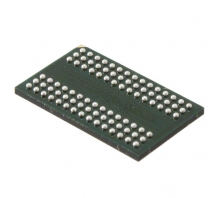
90-TFBGA
Number of Pins
Number of Pins: Indicates the number of electrical connections available on the component. These pins are used to connect the component to other components or circuits on a printed circuit board (PCB). The number of pins determines the functionality and connectivity options of the component. It is important to ensure that the component has the correct number of pins for the intended application.
90
Operating Temperature
Operating Temperature is the range of temperatures at which an electronic component can function properly. It is typically specified in degrees Celsius (°C) and indicates the minimum and maximum temperatures at which the component can operate without experiencing damage or degradation. Operating Temperature is an important parameter to consider when designing electronic circuits, as it ensures that the components will function reliably in the intended operating environment.
-40°C~85°C TA
Packaging
Tape & Reel (TR)
Part Status
Part Status is an electronic component parameter that indicates the availability and production status of a component. It is typically used to inform customers about the availability of a component, whether it is in production, end-of-life, or obsolete. Part Status can also provide information about any restrictions or limitations on the component's use, such as whether it is only available for certain applications or if it has been discontinued.
Obsolete
Moisture Sensitivity Level (MSL)
Moisture Sensitivity Level (MSL) is a measure of the susceptibility of a surface mount electronic component to moisture-induced damage during soldering. It is classified into six levels, from 1 (least sensitive) to 6 (most sensitive). MSL is determined by the materials used in the component's construction, including the solderability of its terminals and the presence of moisture-absorbing materials. Components with higher MSL ratings require more stringent handling and storage conditions to prevent moisture absorption and subsequent damage during soldering.
2 (1 Year)
Technology
Technology, in the context of electronic components, refers to the specific manufacturing process and materials used to create the component. It encompasses the semiconductor fabrication techniques, such as the type of transistor used (e.g., MOSFET, BJT), the gate oxide thickness, and the interconnect materials. Technology also includes the packaging type, such as surface mount or through-hole, and the leadframe or substrate material. The technology used impacts the component's performance characteristics, such as speed, power consumption, and reliability.
SDRAM
Memory Size
256Mb 8M x 32
Memory Type
Memory Type refers to the type of memory technology used in an electronic device. It indicates the specific design and architecture of the memory, such as DRAM (Dynamic Random Access Memory), SRAM (Static Random Access Memory), ROM (Read-Only Memory), EEPROM (Electrically Erasable Programmable Read-Only Memory), or Flash memory. Each memory type has unique characteristics, including speed, capacity, volatility, and cost, which determine its suitability for different applications.
Volatile
Clock Frequency
Clock Frequency, measured in Hertz (Hz), is the rate at which an electronic component, such as a microprocessor or oscillator, generates electrical pulses. It determines the speed at which the component can process data and execute instructions. A higher clock frequency generally indicates faster performance, but also higher power consumption and heat generation. Clock Frequency is a crucial parameter for timing-sensitive applications, such as digital signal processing and real-time systems.
166MHz
Access Time
Access time is the time it takes for a memory device to retrieve data from a specific location. It is typically measured in nanoseconds (ns) and is a critical factor in determining the performance of a computer system. The lower the access time, the faster the memory device can retrieve data and the faster the computer can perform tasks.
5.4ns
Memory Format
Memory Format refers to the arrangement and organization of data within a memory device. It specifies the number of bits, bytes, or words stored in each memory location and how they are accessed.
DRAM
Memory Interface
Parallel
Data Bus Width
Data Bus Width refers to the number of bits that can be transmitted simultaneously on a data bus. It determines the amount of data that can be transferred between components in a single operation. A wider data bus allows for faster data transfer rates and higher system performance. Common data bus widths include 8, 16, 32, and 64 bits, with wider buses typically found in high-performance systems.
32b
RoHS Status
Non-RoHS Compliant
Description
The IS42S32800DIS45S32800D8M is a 256Mb Synchronous DRAM (SDRAM) organized as 2Meg x 32 bit x 4 banks. It operates at clock frequencies of 166 and 143 MHz and features a fully synchronous design with all signals referenced to a positive clock edge. The SDRAM incorporates an internal bank to hide row access and precharge operations, enhancing performance.
Features
Clock frequency: 166, 143 MHz
Fully synchronous design
Internal bank for hiding row access/precharge
Single power supply: 3.3V 0.3V
LVTTL interface
Programmable burst length (1, 2, 4, 8, full page)
Programmable burst sequence (sequential/interleave)
Auto Refresh (CBR)
Self Refresh
4096 refresh cycles every 16ms (A2 grade) or 64 ms (Commercial, Industrial, A1 grade)
Random column address every clock cycle
Programmable CAS latency (2, 3 clocks)
Burst read/write and burst read/single write operations capability
Burst termination by burst stop and precharge command
Applications
High-speed data transfer applications
Pipeline architectures
Embedded systems
Networking equipment
Graphics cards
Gaming consoles