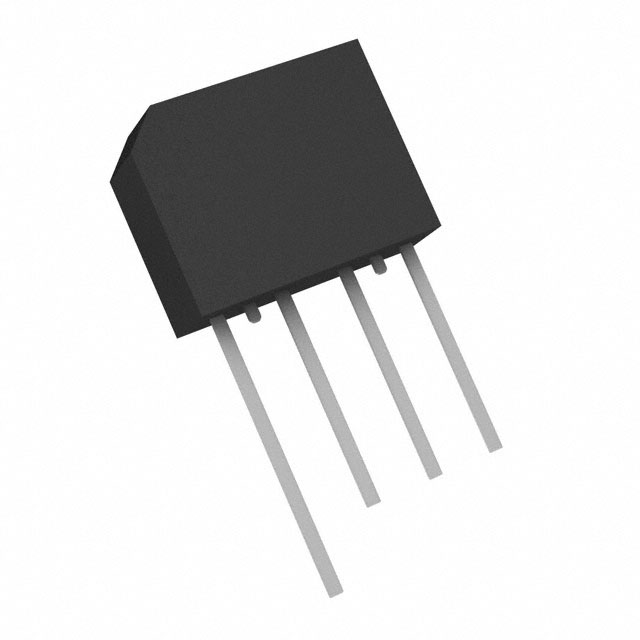
Factory Lead Time
12 Weeks
Mounting Type
Mounting Type refers to the method by which an electronic component is attached to a printed circuit board (PCB) or other surface. Common mounting types include:
* Through-hole: Component leads are inserted into holes in the PCB and soldered on the other side.
* Surface-mount: Component is placed on the surface of the PCB and soldered in place.
* Press-fit: Component is pressed into place on the PCB without soldering.
* Socket: Component is inserted into a socket on the PCB, allowing for easy replacement.
The mounting type is determined by factors such as the component's size, shape, and power requirements.
Through Hole
Package / Case
Package / Case refers to the physical housing or enclosure that encapsulates an electronic component. It provides protection, facilitates handling, and enables electrical connections. The package type determines the component's size, shape, pin configuration, and mounting options. Common package types include DIP (dual in-line package), SOIC (small outline integrated circuit), and BGA (ball grid array). The package also influences the component's thermal and electrical performance.
4-SIP, KBP
Operating Temperature
Operating Temperature is the range of temperatures at which an electronic component can function properly. It is typically specified in degrees Celsius (°C) and indicates the minimum and maximum temperatures at which the component can operate without experiencing damage or degradation. Operating Temperature is an important parameter to consider when designing electronic circuits, as it ensures that the components will function reliably in the intended operating environment.
-55°C~150°C TJ
Part Status
Part Status is an electronic component parameter that indicates the availability and production status of a component. It is typically used to inform customers about the availability of a component, whether it is in production, end-of-life, or obsolete. Part Status can also provide information about any restrictions or limitations on the component's use, such as whether it is only available for certain applications or if it has been discontinued.
Active
Moisture Sensitivity Level (MSL)
Moisture Sensitivity Level (MSL) is a measure of the susceptibility of a surface mount electronic component to moisture-induced damage during soldering. It is classified into six levels, from 1 (least sensitive) to 6 (most sensitive). MSL is determined by the materials used in the component's construction, including the solderability of its terminals and the presence of moisture-absorbing materials. Components with higher MSL ratings require more stringent handling and storage conditions to prevent moisture absorption and subsequent damage during soldering.
1 (Unlimited)
Technology
Technology, in the context of electronic components, refers to the specific manufacturing process and materials used to create the component. It encompasses the semiconductor fabrication techniques, such as the type of transistor used (e.g., MOSFET, BJT), the gate oxide thickness, and the interconnect materials. Technology also includes the packaging type, such as surface mount or through-hole, and the leadframe or substrate material. The technology used impacts the component's performance characteristics, such as speed, power consumption, and reliability.
Standard
Diode Type
Diode Type refers to the specific type of diode used in an electronic circuit. Diodes are semiconductor devices that allow current to flow in only one direction. Different types of diodes have different characteristics and applications.
Single Phase
Current - Reverse Leakage @ Vr
10μA @ 400V
Voltage - Forward (Vf) (Max) @ If
1.1V @ 2A
Current - Average Rectified (Io)
2A
Voltage - Peak Reverse (Max)
400V
RoHS Status
ROHS3 Compliant
KBP204G-G Overview
Basically, rectifier is a type of electronic component that is available in a 4-SIP, KBP package.The mounting method of the device is Through Hole.Operating at the temperature of -55°C~150°C TJ ensures its normal operation.
KBP204G-G Features
4-SIP, KBP package
operating at a temperature of -55°C~150°C TJ
KBP204G-G Applications
There are a lot of Comchip Technology
KBP204G-G applications of bridge rectifiers.
Controlled avalanche characteristics
Working peak reverse voltages 200 to 1 ,000 volts
Military and other high-reliability applications
High forward surge current capability
Low thermal resistance
Extremely robust construction
Fuse-in-glass diodes design
Electrically isolated aluminum case
Motor controls – Low Voltage and Medium Voltage converters
SCR power bridges for solid state starters
KBP204G-G More Descriptions
Bridge Rectifier Single Phase Standard 400V Through Hole KBP
Glass Passivated Bridge Rectifiers
BRIDGE RECT 1PHASE 400V 2A KBP