Factory Lead Time
20 Weeks
Mounting Type
Mounting Type refers to the method by which an electronic component is attached to a printed circuit board (PCB) or other surface. Common mounting types include:
* Through-hole: Component leads are inserted into holes in the PCB and soldered on the other side.
* Surface-mount: Component is placed on the surface of the PCB and soldered in place.
* Press-fit: Component is pressed into place on the PCB without soldering.
* Socket: Component is inserted into a socket on the PCB, allowing for easy replacement.
The mounting type is determined by factors such as the component's size, shape, and power requirements.
Surface Mount
Package / Case
Package / Case refers to the physical housing or enclosure that encapsulates an electronic component. It provides protection, facilitates handling, and enables electrical connections. The package type determines the component's size, shape, pin configuration, and mounting options. Common package types include DIP (dual in-line package), SOIC (small outline integrated circuit), and BGA (ball grid array). The package also influences the component's thermal and electrical performance.
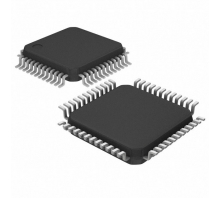
48-LQFP
Operating Temperature
Operating Temperature is the range of temperatures at which an electronic component can function properly. It is typically specified in degrees Celsius (°C) and indicates the minimum and maximum temperatures at which the component can operate without experiencing damage or degradation. Operating Temperature is an important parameter to consider when designing electronic circuits, as it ensures that the components will function reliably in the intended operating environment.
-40°C~85°C
Part Status
Part Status is an electronic component parameter that indicates the availability and production status of a component. It is typically used to inform customers about the availability of a component, whether it is in production, end-of-life, or obsolete. Part Status can also provide information about any restrictions or limitations on the component's use, such as whether it is only available for certain applications or if it has been discontinued.
Active
Moisture Sensitivity Level (MSL)
Moisture Sensitivity Level (MSL) is a measure of the susceptibility of a surface mount electronic component to moisture-induced damage during soldering. It is classified into six levels, from 1 (least sensitive) to 6 (most sensitive). MSL is determined by the materials used in the component's construction, including the solderability of its terminals and the presence of moisture-absorbing materials. Components with higher MSL ratings require more stringent handling and storage conditions to prevent moisture absorption and subsequent damage during soldering.
3 (168 Hours)
Voltage - Supply
2.85V~5.25V
Function
Function refers to the primary purpose or role of an electronic component within a circuit. It describes the specific task or operation that the component is designed to perform. For example, a resistor's function is to limit current flow, a capacitor's function is to store electrical energy, and a transistor's function is to amplify or switch signals. Understanding the function of a component is crucial for selecting the appropriate component for a particular application and ensuring its proper operation within the circuit.
Temp Monitoring System (Sensor)
Output Type
Output type refers to the type of signal or power that an electronic component can produce. It can be analog or digital, AC or DC, and can vary in voltage, current, or power levels. The output type is determined by the component's design and is crucial for matching it with other components in a circuit. Understanding the output type ensures proper signal processing, power delivery, and overall system functionality.
SPI
Topology
ADC (Sigma Delta), Multiplexer, Register Bank
Sensor Type
Sensor Type refers to the physical principle or mechanism used by a sensor to detect and measure a specific physical quantity or phenomenon. It indicates the underlying technology or method employed by the sensor to convert the measured quantity into an electrical signal.
External
Sensing Temperature
-265°C~1800°C
RoHS Status
ROHS3 Compliant
Description
The LTC2983 is a multi-sensor, high-accuracy digital temperature measurement system that directly digitizes RTDs, thermocouples, thermistors, and diodes. It operates on a single 2.85V to 5.25V supply and reports results in °C or °F with 0.1°C accuracy and 0.001°C resolution. The LTC2983 features 20 flexible inputs, allowing for interchangeable sensors and various configuration options. It includes automatic thermocouple cold junction compensation, built-in standard and user-programmable coefficients for thermocouples, RTDs, and thermistors, and configurable 2-, 3-, or 4-wire RTD configurations. The device also measures negative thermocouple voltages and provides automatic burn out, short-circuit, and fault detection. Its buffered inputs allow for external protection, and it offers simultaneous 50Hz/60Hz rejection. The LTC2983 includes a 15ppm/°C (maximum) reference (1-grade).
Features
Direct digitization of RTDs, thermocouples, thermistors, and diodes
Single 2.85V to 5.25V supply
Results reported in °C or °F
20 flexible inputs for interchangeable sensors
Automatic thermocouple cold junction compensation
Built-in standard and user-programmable coefficients for thermocouples, RTDs, and thermistors
Configurable 2-, 3-, or 4-wire RTD configurations
Measures negative thermocouple voltages
Automatic burn out, short-circuit, and fault detection
Buffered inputs for external protection
Simultaneous 50Hz/60Hz rejection
Includes 15ppm/°C (maximum) reference (1-grade)
Applications
Direct thermocouple measurements
Direct RTD measurements
Direct thermistor measurements
Custom sensor applications