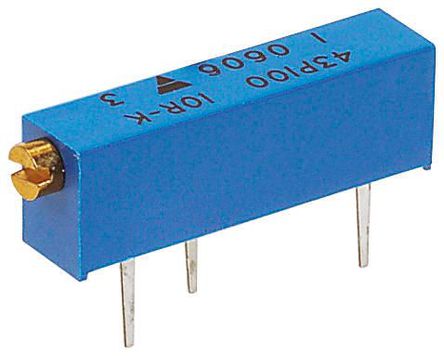
Factory Lead Time
18 Weeks
Tolerance
Tolerance in electronic components refers to the allowable deviation from the specified value. It indicates the range within which the actual value of the component can vary while still meeting the manufacturer's specifications. Tolerance is typically expressed as a percentage of the nominal value, such as ±5% or ±10%. A lower tolerance indicates a tighter range of acceptable values, resulting in more precise and consistent performance.
10%
Part Status
Part Status is an electronic component parameter that indicates the availability and production status of a component. It is typically used to inform customers about the availability of a component, whether it is in production, end-of-life, or obsolete. Part Status can also provide information about any restrictions or limitations on the component's use, such as whether it is only available for certain applications or if it has been discontinued.
Active
Termination
Termination refers to the electrical characteristics of a component or circuit at its input or output terminals. It describes how the component or circuit interacts with external signals or devices. Termination can involve matching impedance, providing voltage or current regulation, or filtering unwanted signals. Proper termination ensures efficient signal transfer, minimizes reflections, and prevents damage to components. It is crucial for maintaining signal integrity and optimizing circuit performance.
Pin
Temperature Coefficient
Temperature Coefficient (TC) measures the relative change in a component's value due to temperature variations. It is expressed as a percentage change per degree Celsius (°C). A positive TC indicates an increase in value with increasing temperature, while a negative TC indicates a decrease. TC is crucial for ensuring stable circuit performance over a range of temperatures. It helps designers compensate for temperature-induced changes and maintain desired component characteristics.
100 ppm/°C
Resistance
Resistance is a measure of the opposition to the flow of electric current in a conductor. It is measured in ohms (Ω). The higher the resistance, the more difficult it is for current to flow. Resistance is caused by the collisions of electrons with atoms and molecules in the conductor. The more collisions that occur, the higher the resistance.
20Ohm
Max Operating Temperature
125°C
Min Operating Temperature
-55°C
Lead Length
Lead length refers to the distance between the body of an electronic component and the point where its leads or terminals emerge. It is a crucial parameter that affects the component's performance, reliability, and ease of assembly. Lead length influences factors such as inductance, capacitance, and heat dissipation. Longer leads can increase inductance and capacitance, which may impact signal integrity and circuit performance. They can also affect heat dissipation, as longer leads provide a larger surface area for heat transfer. Optimal lead length is determined based on the component's intended application and the desired electrical and thermal characteristics.
5.3mm
Number of Turns
Number of Turns refers to the number of times a wire is wrapped around a core in an electronic component, such as an inductor or transformer. It is a crucial parameter that determines the inductance, which is the ability of the component to store energy in a magnetic field. A higher number of turns generally results in higher inductance, making the component more effective in filtering or storing electrical energy.
20
Height
Height, in the context of electronic components, refers to the vertical dimension of the component. It is typically measured in millimeters (mm) or inches (in). Height is an important parameter to consider when designing and assembling electronic circuits, as it affects the overall size and form factor of the device. Components with a smaller height are often preferred for applications where space is limited, such as in portable devices or embedded systems.
6.35mm
Length
Length, in the context of electronic components, refers to the physical dimension of a component along its longest axis. It is typically measured in millimeters (mm) or inches (in). Length is a crucial parameter for determining the physical size and space requirements of a component on a printed circuit board (PCB) or other assembly. It also affects the component's electrical characteristics, such as inductance and capacitance, which can be influenced by the length of conductors or traces within the component.
20.5mm
RoHS Status
ROHS3 Compliant
M43P200KB40 OverviewThis product is manufactured by Vishay Spectrol and belongs to the category of Trimmer Potentiometers. The images we provide are for reference only, for detailed product information please see specification sheet M43P200KB40 or the datasheet in PDF format. As a professional electronic components distributor, Zeano has five million electronic components available. Additionally, we have over 500,000 electronic components in stock ready for immediate shipment. If you have requirements, you can send us a quotation form to get the price of M43P200KB40. We attach great importance to our customers' purchasing experience and are willing to establish a long-term cooperative relationship with you. If you have any questions or requirements, please feel free to contact us.
M43P200KB40 More Descriptions
Resistor Trimmer, Cermet, 20 Ohm, ± 10%, 750 mW, 18 Turn, Multi Turn, Through Hole
Res Cermet Trimmer 20 Ohm 10% 0.5W(1/2W) 15(Elec)/18(Mech)Turns 2.5mm (20.5 X 4.7 X 6.4mm) Pin Thru-Hole Box
Trimmer, Cermet, Rest 20 Ohms, PCB, 15 Turns, Pwr-Rtg 0.5 W, Linear
Multi-Turn Trimmers/Potentiometers 3/4 REC 20OHMS 10% Cermet Panel Mount
TRIMMER, 20 TURN 20R; Track Resistance:20ohm; No. of Turns:18; Resistance Tolerance:± 10%; Series:43P; Temperature Coefficient:± 100ppm/°C; Power Rating:500mW; Mounting Type:Through Hole; SVHC:No SVHC; Resistor Element Type:Variable ;RoHS Compliant: Yes
TRIMMER, 20 TURN 20R; Track Resistance:20ohm; No. of Turns:18; Resistance Tolerance:± 10%; Series:43P; Temperature Coefficient:± 100ppm/°C; Power Rating:500mW; Potentiometer Mounting:Through Hole; SVHC:No SVHC (15-Dec-2010); Adjustment Type:Horizontal; Approval Category:MIL-R-22097; Contact Resistance Variation :2%; End Resistance:1ohm; External Depth:4.8mm; External Length / Height:6.35mm; Full Power Rating Temperature:25°C; Lead Diameter:0.5mm; Lead Length:5.3mm; Operating Temperature Max:125°C; Operating Temperature Min:-55°C; Operating Temperature Range:-55°C to 125°C; Package / Case:PCB Mount; Proof Voltage:1000V; Resistance:20ohm; Resistor Element Material:Variable Rotary Cermet; Temperature Coeff. :100ppm/°C; Temperature Coeff. -:100ppm/°C; Terminal Type:PCB Terminals; Termination Type:Radial Leaded; Tolerance :10%; Tolerance -:10%; Track Taper:Linear; Voltage Rating:400V; Voltage Rating VDC:250V