Factory Lead Time
6 Weeks
Mounting Type
Mounting Type refers to the method by which an electronic component is attached to a printed circuit board (PCB) or other surface. Common mounting types include:
* Through-hole: Component leads are inserted into holes in the PCB and soldered on the other side.
* Surface-mount: Component is placed on the surface of the PCB and soldered in place.
* Press-fit: Component is pressed into place on the PCB without soldering.
* Socket: Component is inserted into a socket on the PCB, allowing for easy replacement.
The mounting type is determined by factors such as the component's size, shape, and power requirements.
Surface Mount
Package / Case
Package / Case refers to the physical housing or enclosure that encapsulates an electronic component. It provides protection, facilitates handling, and enables electrical connections. The package type determines the component's size, shape, pin configuration, and mounting options. Common package types include DIP (dual in-line package), SOIC (small outline integrated circuit), and BGA (ball grid array). The package also influences the component's thermal and electrical performance.
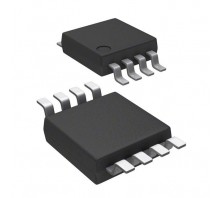
8-TSSOP, 8-MSOP (0.118, 3.00mm Width)
Operating Temperature
Operating Temperature is the range of temperatures at which an electronic component can function properly. It is typically specified in degrees Celsius (°C) and indicates the minimum and maximum temperatures at which the component can operate without experiencing damage or degradation. Operating Temperature is an important parameter to consider when designing electronic circuits, as it ensures that the components will function reliably in the intended operating environment.
-40°C~85°C
Packaging
Tape & Reel (TR)
Part Status
Part Status is an electronic component parameter that indicates the availability and production status of a component. It is typically used to inform customers about the availability of a component, whether it is in production, end-of-life, or obsolete. Part Status can also provide information about any restrictions or limitations on the component's use, such as whether it is only available for certain applications or if it has been discontinued.
Active
Moisture Sensitivity Level (MSL)
Moisture Sensitivity Level (MSL) is a measure of the susceptibility of a surface mount electronic component to moisture-induced damage during soldering. It is classified into six levels, from 1 (least sensitive) to 6 (most sensitive). MSL is determined by the materials used in the component's construction, including the solderability of its terminals and the presence of moisture-absorbing materials. Components with higher MSL ratings require more stringent handling and storage conditions to prevent moisture absorption and subsequent damage during soldering.
1 (Unlimited)
Terminal Finish
MATTE TIN
Subcategory
Other Converters
Technology
Technology, in the context of electronic components, refers to the specific manufacturing process and materials used to create the component. It encompasses the semiconductor fabrication techniques, such as the type of transistor used (e.g., MOSFET, BJT), the gate oxide thickness, and the interconnect materials. Technology also includes the packaging type, such as surface mount or through-hole, and the leadframe or substrate material. The technology used impacts the component's performance characteristics, such as speed, power consumption, and reliability.
BICMOS
Peak Reflow Temperature (Cel)
260
Supply Voltage
Supply Voltage is the voltage required to power an electronic component. It is typically measured in volts (V) and is specified in the component's datasheet. The supply voltage must be within the specified range for the component to function properly. If the supply voltage is too low, the component may not function at all. If the supply voltage is too high, the component may be damaged.
5V
Output Type
Output type refers to the type of signal or power that an electronic component can produce. It can be analog or digital, AC or DC, and can vary in voltage, current, or power levels. The output type is determined by the component's design and is crucial for matching it with other components in a circuit. Understanding the output type ensures proper signal processing, power delivery, and overall system functionality.
Voltage - Unbuffered
Architecture
Architecture refers to the internal design and organization of an electronic component. It encompasses the arrangement of functional blocks, their interconnections, and the overall data flow within the component. The architecture determines the component's performance characteristics, such as speed, power consumption, and functionality. It also influences the component's size, cost, and reliability.
R-2R
Converter Type
Converter Type refers to the type of conversion performed by an electronic component, such as an analog-to-digital converter (ADC) or a digital-to-analog converter (DAC). It specifies the input and output signal types that the converter can handle.
D/A CONVERTER
Reference Type
Reference type is a parameter that specifies the type of reference used in an electronic component. It can be either a voltage reference or a current reference. A voltage reference provides a stable voltage output, while a current reference provides a stable current output. The type of reference used depends on the application. For example, a voltage reference is used in a voltage regulator to provide a stable voltage output, while a current reference is used in a current source to provide a stable current output.
External
Data Interface
Data Interface refers to the physical and logical means by which an electronic component communicates with other components or systems. It defines the protocols, pinouts, and signal characteristics used for data exchange. The Data Interface parameter specifies the type of interface supported by the component, such as SPI, I2C, UART, or Ethernet. It ensures compatibility and proper communication between different devices within a system.
SPI
Differential Output
Differential Output is a parameter that describes the output signal of an electronic component. It refers to the difference in voltage or current between two output terminals. Differential outputs are commonly used in high-speed circuits and applications where noise immunity is important. By transmitting the signal as a differential pair, the common-mode noise is canceled out, resulting in a more robust and reliable signal.
No
Voltage - Supply, Analog
5V
Number of D/A Converters
1
Analog Output Voltage-Max
2.5V
Length
Length, in the context of electronic components, refers to the physical dimension of a component along its longest axis. It is typically measured in millimeters (mm) or inches (in). Length is a crucial parameter for determining the physical size and space requirements of a component on a printed circuit board (PCB) or other assembly. It also affects the component's electrical characteristics, such as inductance and capacitance, which can be influenced by the length of conductors or traces within the component.
3mm
RoHS Status
ROHS3 Compliant
Description
The MAX5141-MAX5144 are serial-input, voltage-output, 14-bit digital-to-analog converters (DACs) in tiny UMAX packages, 50% smaller than comparable DACs in an 8-pin SO. They operate from low 3V (MAX5143/MAX5144) or 5V (MAX5141/MAX5142) single supplies. They provide 14-bit performance ( 1LSB INL and DNL) over temperature without any adjustments. The DAC output is unbuffered, resulting in a low supply current of 120µA and a low offset error of 2LSBs.
The DAC output range is 0V to VREF. For bipolar operation, matched scaling resistors are provided in the MAX5142/MAX5144 for use with an external precision op-amp (such as the MAX400), generating a VREF output swing.
A 16-bit serial word is used to load data into the DAC latch. The 25MHz, 3-wire serial interface is compatible with SPI/QSPI/MICROWIRE, and can interface directly with optocouplers for applications requiring isolation. A power-on reset circuit clears the DAC output to code 0 (MAX5141/MAX5143) or code 8192 (MAX5142/MAX5144) when power is initially applied.
A logic low on CLR asynchronously clears the DAC output to code 0 (MAX5141/MAX5143) or code 8192 (MAX5142/MAX5144), independent of the serial interface.
The MAX5141/MAX5143 are available in 8-pin μMAX packages and the MAX5142/MAX5144 are available in 10-pin UMAX packages.
Features
Miniature (3mm x 5mm) 8-Pin μMAX Package
Low 120μA Supply Current
Fast 1μs Settling Time
25MHZ SPI/QSPI/MICROWIRE-Compatible Serial Interface
VREF Range Extends to VDD
5V (MAX5141/MAX5142) or 3V (MAX5143/MAX5144) Single-Supply Operation
Full 14-Bit Performance Without Adjustments
Unbuffered Voltage Output Directly Drives 60kΩ Loads
Power-On Reset Circuit Clears DAC Output to Code 0 (MAX5141/MAX5143) or Code 8192 (MAX5142/MAX5144)
Schmitt-Trigger Inputs for Direct Optocoupler Interface
Asynchronous CLR
Applications
High-Resolution and Gain Adjustment
Industrial Process Control
Automated Test Equipment
Data-Acquisition Systems