Mounting Type
Mounting Type refers to the method by which an electronic component is attached to a printed circuit board (PCB) or other surface. Common mounting types include:
* Through-hole: Component leads are inserted into holes in the PCB and soldered on the other side.
* Surface-mount: Component is placed on the surface of the PCB and soldered in place.
* Press-fit: Component is pressed into place on the PCB without soldering.
* Socket: Component is inserted into a socket on the PCB, allowing for easy replacement.
The mounting type is determined by factors such as the component's size, shape, and power requirements.
Through Hole
Package / Case
Package / Case refers to the physical housing or enclosure that encapsulates an electronic component. It provides protection, facilitates handling, and enables electrical connections. The package type determines the component's size, shape, pin configuration, and mounting options. Common package types include DIP (dual in-line package), SOIC (small outline integrated circuit), and BGA (ball grid array). The package also influences the component's thermal and electrical performance.
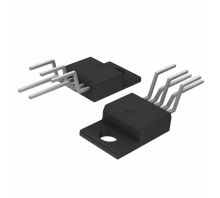
TO-220-5 Formed Leads
Operating Temperature
Operating Temperature is the range of temperatures at which an electronic component can function properly. It is typically specified in degrees Celsius (°C) and indicates the minimum and maximum temperatures at which the component can operate without experiencing damage or degradation. Operating Temperature is an important parameter to consider when designing electronic circuits, as it ensures that the components will function reliably in the intended operating environment.
0°C~70°C TA
Part Status
Part Status is an electronic component parameter that indicates the availability and production status of a component. It is typically used to inform customers about the availability of a component, whether it is in production, end-of-life, or obsolete. Part Status can also provide information about any restrictions or limitations on the component's use, such as whether it is only available for certain applications or if it has been discontinued.
Obsolete
Moisture Sensitivity Level (MSL)
Moisture Sensitivity Level (MSL) is a measure of the susceptibility of a surface mount electronic component to moisture-induced damage during soldering. It is classified into six levels, from 1 (least sensitive) to 6 (most sensitive). MSL is determined by the materials used in the component's construction, including the solderability of its terminals and the presence of moisture-absorbing materials. Components with higher MSL ratings require more stringent handling and storage conditions to prevent moisture absorption and subsequent damage during soldering.
1 (Unlimited)
Terminal Finish
Tin/Lead (Sn/Pb)
Subcategory
Switching Regulator or Controllers
Technology
Technology, in the context of electronic components, refers to the specific manufacturing process and materials used to create the component. It encompasses the semiconductor fabrication techniques, such as the type of transistor used (e.g., MOSFET, BJT), the gate oxide thickness, and the interconnect materials. Technology also includes the packaging type, such as surface mount or through-hole, and the leadframe or substrate material. The technology used impacts the component's performance characteristics, such as speed, power consumption, and reliability.
BIPOLAR
Terminal Position
ZIG-ZAG
Peak Reflow Temperature (Cel)
240
Time@Peak Reflow Temperature-Max (s)
30
Function
Function refers to the primary purpose or role of an electronic component within a circuit. It describes the specific task or operation that the component is designed to perform. For example, a resistor's function is to limit current flow, a capacitor's function is to store electrical energy, and a transistor's function is to amplify or switch signals. Understanding the function of a component is crucial for selecting the appropriate component for a particular application and ensuring its proper operation within the circuit.
Step-Up, Step-Down
Number of Outputs
Number of Outputs refers to the number of independent output signals or channels that an electronic component can provide. It indicates the capability of the component to drive multiple external devices or circuits simultaneously. A higher number of outputs allows for greater flexibility and connectivity in electronic systems.
1
Output Voltage
Output Voltage is the voltage level produced by an electronic component when it is operating. It is typically measured in volts (V) and can be either positive or negative. The output voltage of a component is determined by its design and the input voltage applied to it. For example, a voltage regulator will produce a fixed output voltage regardless of the input voltage, while an amplifier will produce an output voltage that is proportional to the input voltage.
40V
Output Type
Output type refers to the type of signal or power that an electronic component can produce. It can be analog or digital, AC or DC, and can vary in voltage, current, or power levels. The output type is determined by the component's design and is crucial for matching it with other components in a circuit. Understanding the output type ensures proper signal processing, power delivery, and overall system functionality.
Adjustable
Voltage - Input (Min)
7.5V
Analog IC - Other Type
SWITCHING REGULATOR
Output Configuration
Output Configuration refers to the arrangement of output terminals or pins on an electronic component. It specifies the number, type, and arrangement of these terminals, allowing for various connection options. This parameter is crucial for determining the component's compatibility with other devices and ensuring proper signal flow within a circuit.
Positive or Negative
Current - Output
3.3A Switch
Voltage - Output (Min/Fixed)
5.05V
Control Mode
VOLTAGE-MODE
Frequency - Switching
72kHz
Control Technique
PULSE WIDTH MODULATION
Voltage - Output (Max)
40V Switch
RoHS Status
Non-RoHS Compliant
MC34166TV Overview
This harley voltage regulator utilizes the Tube package for optimized performance. There are 5 terminations in this voltage regulator. The type of analog IC that this voltage regulator is equipped with is SWITCHING REGULATOR. This harley voltage regulator is available in the TO-220-5 Formed Leads package for the purpose of space saving. DC DC switching regulator is configured with 1 outputs. This DC DC switching regulator generates Adjustable output on its output pins. This voltage regulator 12v fits the Through Hole mounting. When operating, adjusting voltage regulator's operating temperature should be kept at 0°C~70°C TA. The switching frequency of this DC-DC switching regulator reaches 72kHz. This voltage regulator is able to operate with the minimal input voltage of 7.5V. DC DC switching regulator's output voltage (Min/Fixed) amounts to 5.05V. The output current of 3.3A Switch makes dc to dc voltage regulator feature maximum design flexibility. The peak reflow temperature of this regulator amounts to 240 to be essentially indestructible. Voltage regulator is designed to provide a nominal input voltage of 12V to meet the operation requirements. This voltage regulator is included in the Switching Regulator or Controllers subcategory. This DC/DC regulator belongs to the MC34166 family. The adjusting voltage regulator's output voltage is maintain at 40V. DC DC switching regulator is able to operate in an easy way on the basis of the maximal output voltage of 40V Switch.
MC34166TV Features
1 outputs
Peak reflow temperature (Cel) of 240
MC34166TV Applications
There are a lot of ON Semiconductor
MC34166TV Voltage Regulators applications.
CNC system
Servo drive system
Digital display device
Linear guide
Ball screw pair
Computer application technology
Network technology
Automation technology
CMM
Various precision measuring instruments
MC34166TV More Descriptions
Switching Regulator, Voltage-mode, 6A, 81kHz Switching Freq-Max, BIPolar, PZFM5
IC REG BUCK BST ADJ 3.3A TO220-5
Converter Ics 40V 3A No-Cancel/No-Return
Voltage Regulators - Switching Regulators 40V 3A
VOLTAGE-MODE Non-RoHS Compliant Adjustable Positive or Negative Switching Regulator IC 0C~70C TA 72kHz 3.3A Switch 12V
CoC and 2-years warranty / RFQ for pricing
French Electronic Distributor since 1988