Factory Lead Time
10 Weeks
Mounting Type
Mounting Type refers to the method by which an electronic component is attached to a printed circuit board (PCB) or other surface. Common mounting types include:
* Through-hole: Component leads are inserted into holes in the PCB and soldered on the other side.
* Surface-mount: Component is placed on the surface of the PCB and soldered in place.
* Press-fit: Component is pressed into place on the PCB without soldering.
* Socket: Component is inserted into a socket on the PCB, allowing for easy replacement.
The mounting type is determined by factors such as the component's size, shape, and power requirements.
Surface Mount
Package / Case
Package / Case refers to the physical housing or enclosure that encapsulates an electronic component. It provides protection, facilitates handling, and enables electrical connections. The package type determines the component's size, shape, pin configuration, and mounting options. Common package types include DIP (dual in-line package), SOIC (small outline integrated circuit), and BGA (ball grid array). The package also influences the component's thermal and electrical performance.
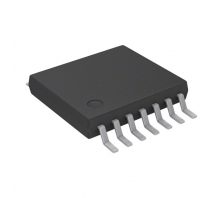
14-TSSOP (0.173, 4.40mm Width)
Number of Pins
Number of Pins: Indicates the number of electrical connections available on the component. These pins are used to connect the component to other components or circuits on a printed circuit board (PCB). The number of pins determines the functionality and connectivity options of the component. It is important to ensure that the component has the correct number of pins for the intended application.
14
Operating Temperature
Operating Temperature is the range of temperatures at which an electronic component can function properly. It is typically specified in degrees Celsius (°C) and indicates the minimum and maximum temperatures at which the component can operate without experiencing damage or degradation. Operating Temperature is an important parameter to consider when designing electronic circuits, as it ensures that the components will function reliably in the intended operating environment.
-40°C~85°C
Packaging
Tape & Reel (TR)
Tolerance
Tolerance in electronic components refers to the allowable deviation from the specified value. It indicates the range within which the actual value of the component can vary while still meeting the manufacturer's specifications. Tolerance is typically expressed as a percentage of the nominal value, such as ±5% or ±10%. A lower tolerance indicates a tighter range of acceptable values, resulting in more precise and consistent performance.
±30%
Part Status
Part Status is an electronic component parameter that indicates the availability and production status of a component. It is typically used to inform customers about the availability of a component, whether it is in production, end-of-life, or obsolete. Part Status can also provide information about any restrictions or limitations on the component's use, such as whether it is only available for certain applications or if it has been discontinued.
Active
Moisture Sensitivity Level (MSL)
Moisture Sensitivity Level (MSL) is a measure of the susceptibility of a surface mount electronic component to moisture-induced damage during soldering. It is classified into six levels, from 1 (least sensitive) to 6 (most sensitive). MSL is determined by the materials used in the component's construction, including the solderability of its terminals and the presence of moisture-absorbing materials. Components with higher MSL ratings require more stringent handling and storage conditions to prevent moisture absorption and subsequent damage during soldering.
1 (Unlimited)
Number of Terminations
14
Temperature Coefficient
Temperature Coefficient (TC) measures the relative change in a component's value due to temperature variations. It is expressed as a percentage change per degree Celsius (°C). A positive TC indicates an increase in value with increasing temperature, while a negative TC indicates a decrease. TC is crucial for ensuring stable circuit performance over a range of temperatures. It helps designers compensate for temperature-induced changes and maintain desired component characteristics.
800 ppm/°C
Resistance
Resistance is a measure of the opposition to the flow of electric current in a conductor. It is measured in ohms (Ω). The higher the resistance, the more difficult it is for current to flow. Resistance is caused by the collisions of electrons with atoms and molecules in the conductor. The more collisions that occur, the higher the resistance.
100kOhm
Number of Positions
Number of Positions, in the context of electronic components, refers to the number of distinct terminals or connection points available on the component. It indicates the number of individual electrical connections that can be made to the component. A higher number of positions typically allows for more complex functionality and versatility in circuit design.
256
Terminal Finish
Matte Tin (Sn)
Technology
Technology, in the context of electronic components, refers to the specific manufacturing process and materials used to create the component. It encompasses the semiconductor fabrication techniques, such as the type of transistor used (e.g., MOSFET, BJT), the gate oxide thickness, and the interconnect materials. Technology also includes the packaging type, such as surface mount or through-hole, and the leadframe or substrate material. The technology used impacts the component's performance characteristics, such as speed, power consumption, and reliability.
CMOS
Voltage - Supply
2.7V~5.5V
Peak Reflow Temperature (Cel)
260
Supply Voltage
Supply Voltage is the voltage required to power an electronic component. It is typically measured in volts (V) and is specified in the component's datasheet. The supply voltage must be within the specified range for the component to function properly. If the supply voltage is too low, the component may not function at all. If the supply voltage is too high, the component may be damaged.
5V
Frequency
Frequency, in the context of electronic components, refers to the rate at which an alternating current or voltage changes direction per second. It is measured in Hertz (Hz), which represents one cycle per second. Frequency is a crucial parameter for various electronic components, such as capacitors, inductors, and resonators. It determines the component's ability to store or release energy, filter signals, and resonate at specific frequencies. Understanding the frequency characteristics of electronic components is essential for designing and optimizing electronic circuits.
10MHz
Reflow Temperature-Max (s)
40
Base Part Number
MCP42100
Configuration
Potentiometer
Number of Channels
Number of Channels refers to the number of independent signal paths within an electronic component. It indicates how many separate signals can be processed or transmitted simultaneously. For example, an audio amplifier with two channels can amplify two separate audio signals, while a multi-channel data converter can convert multiple analog signals into digital data. The number of channels is a crucial parameter for determining the component's functionality and application.
1
Interface
In electronics, an interface refers to the connection point or boundary between two or more electronic systems or devices. It defines the physical, electrical, and logical characteristics that enable communication and data exchange between them.
An interface specifies the protocols, pinouts, voltage levels, data formats, and other parameters necessary for the systems to interact seamlessly. It ensures compatibility and interoperability between different components or devices, allowing them to exchange information and perform their intended functions.
SPI
Number of Circuits
Number of Circuits refers to the number of independent signal paths within an electronic component. It indicates how many separate circuits or channels the component can handle simultaneously. For example, an operational amplifier with a Number of Circuits of 2 can amplify two separate input signals independently. This parameter is crucial for determining the component's functionality and its suitability for specific applications.
2
Nominal Supply Current
340μA
Memory Type
Memory Type refers to the type of memory technology used in an electronic device. It indicates the specific design and architecture of the memory, such as DRAM (Dynamic Random Access Memory), SRAM (Static Random Access Memory), ROM (Read-Only Memory), EEPROM (Electrically Erasable Programmable Read-Only Memory), or Flash memory. Each memory type has unique characteristics, including speed, capacity, volatility, and cost, which determine its suitability for different applications.
Volatile
Quiescent Current
Quiescent current is the amount of current drawn by an electronic component when it is not actively performing its intended function. It is typically measured in milliamps (mA) or microamps (µA). Quiescent current is important because it can affect the overall power consumption of a circuit, especially in battery-powered devices. Components with high quiescent current can drain batteries more quickly than those with low quiescent current.
10nA
Bandwidth
Bandwidth, in the context of electronic components, refers to the range of frequencies over which a component can operate effectively. It is typically measured in Hertz (Hz) and indicates the component's ability to pass signals within a specific frequency range without significant attenuation or distortion. A higher bandwidth indicates a wider range of frequencies that the component can handle, while a lower bandwidth indicates a narrower range. Bandwidth is a crucial parameter for components such as amplifiers, filters, and communication systems, as it determines the frequency range over which they can perform their intended functions.
0.145 kHz
Number of Taps
Number of Taps refers to the number of connections or terminals available on a transformer or inductor. Each tap provides access to a different voltage level or impedance point within the component. By connecting to different taps, the user can adjust the output voltage or impedance to suit their specific application. The number of taps available determines the flexibility and versatility of the component.
256
Total Resistance
100000Ohm
Resistance - Wiper (Ω) (Typ)
175
Resistor Terminal Voltage-Max
5V
Length
Length, in the context of electronic components, refers to the physical dimension of a component along its longest axis. It is typically measured in millimeters (mm) or inches (in). Length is a crucial parameter for determining the physical size and space requirements of a component on a printed circuit board (PCB) or other assembly. It also affects the component's electrical characteristics, such as inductance and capacitance, which can be influenced by the length of conductors or traces within the component.
5mm
RoHS Status
ROHS3 Compliant
MCP42100T-I/ST Overview
14-TSSOP (0.173, 4.40mm Width) packages contain it.As of Volatile, this pentometer has been stored.This digital potentiometer has 2 embedded circuits.In the Tape & Reel (TR) package, it is accessible for securing the digital analogic.This pentometer is protected from overcurrent by 256 taps.Positions are 256.It is designed 14 terminations.You can refer to 2 functions in this programmable potentiometer.The total resistance of the speed potentiometers will be 100000Ohm as shown.The performance of this product is a result of 5V.The digi devices shows the 14 pins.The way to mount is Surface Mount.potentionmeters with 2.7V~5.5V voltage capabilities can be used.This digital potentiometer operates at 0°C.There is a possibility of limiting the flow by 100kOhm.Pentometer belongs to the family MCP42100.A mount of Surface Mount is used for digital potentiometer.14 pins are present on this potentiameter.Cascade Pin can be found when using this digital variable resistor.Voltage can be delivered at 3/5V.Despite its 10MHz frequency, it can maintain high accuracy.Quiescent current is consumed at 10nA.In this programmable potentiometer, there are 1 channels.
MCP42100T-I/ST Features
Available in 14-TSSOP (0.173, 4.40mm Width) package
2 Circuits
Mounting Type: Surface Mount
Operate temperature at the range of -40°C~85°C
14 pins
Quiescent Current at 10nA
MCP42100T-I/ST Applications
There are a lot of Microchip Technology MCP42100T-I/ST Digital Potentiometers applications.
Audio Volume control
Sensor auto referencing circuits
Analogue circuit
Audio level control
Adjustable gain amplifiers
Used as variable resistor
Contrast control of monitors
Household appliances
Joysticks
Stereo
MCP42100T-I/ST More Descriptions
MCP42 Series Dual 8-Bit 256 Step SPI 100 kOhm Volatile Digital POT-TSSOP-14
Digital Potentiometer 100kOhm 256POS Volatile Linear 14-Pin TSSOP T/R
Digital Pot 256 steps SPI 100kohms dual channel
Ic,digital Potentiometer,cmos,tssop,14Pin,plastic Rohs Compliant: Yes |Microchip MCP42100T-I/ST
Digital Potentiometers, 256Taps, -40 to 125°C, TSSOP-14, RoHSMicrochip SCT
Digital Potentiometers with SPI Interface 256 Step SPI 100kOhm
Digital Potentiometer, 2 Func, 100000ohm, 3-wire Serial Control Interface, 256 Positions, CMOS, PDSO14
IC DGT POT 100KOHM 256TP 14TSSOP
Digital Potentiometer ICs 256 Step SPI 100kOhm
TSSOP-14 Pre-ordered MCUs ROHS
IC POT DGTL 100K 2CH SPI 14TSSOP
IC DGT POT 100KOHM 256TAP 14SOIC
Digital Pot, 256 steps, SPI, 10 RoHSconf