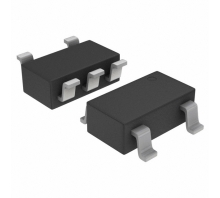
Factory Lead Time
5 Weeks
Lifecycle Status
ACTIVE (Last Updated: 4 days ago)
Mounting Type
Mounting Type refers to the method by which an electronic component is attached to a printed circuit board (PCB) or other surface. Common mounting types include:
* Through-hole: Component leads are inserted into holes in the PCB and soldered on the other side.
* Surface-mount: Component is placed on the surface of the PCB and soldered in place.
* Press-fit: Component is pressed into place on the PCB without soldering.
* Socket: Component is inserted into a socket on the PCB, allowing for easy replacement.
The mounting type is determined by factors such as the component's size, shape, and power requirements.
Surface Mount
Package / Case
Package / Case refers to the physical housing or enclosure that encapsulates an electronic component. It provides protection, facilitates handling, and enables electrical connections. The package type determines the component's size, shape, pin configuration, and mounting options. Common package types include DIP (dual in-line package), SOIC (small outline integrated circuit), and BGA (ball grid array). The package also influences the component's thermal and electrical performance.
SOT-23-5 Thin, TSOT-23-5
Number of Pins
Number of Pins: Indicates the number of electrical connections available on the component. These pins are used to connect the component to other components or circuits on a printed circuit board (PCB). The number of pins determines the functionality and connectivity options of the component. It is important to ensure that the component has the correct number of pins for the intended application.
5
Operating Temperature
Operating Temperature is the range of temperatures at which an electronic component can function properly. It is typically specified in degrees Celsius (°C) and indicates the minimum and maximum temperatures at which the component can operate without experiencing damage or degradation. Operating Temperature is an important parameter to consider when designing electronic circuits, as it ensures that the components will function reliably in the intended operating environment.
-40°C~125°C
Packaging
Tape & Reel (TR)
Part Status
Part Status is an electronic component parameter that indicates the availability and production status of a component. It is typically used to inform customers about the availability of a component, whether it is in production, end-of-life, or obsolete. Part Status can also provide information about any restrictions or limitations on the component's use, such as whether it is only available for certain applications or if it has been discontinued.
Active
Moisture Sensitivity Level (MSL)
Moisture Sensitivity Level (MSL) is a measure of the susceptibility of a surface mount electronic component to moisture-induced damage during soldering. It is classified into six levels, from 1 (least sensitive) to 6 (most sensitive). MSL is determined by the materials used in the component's construction, including the solderability of its terminals and the presence of moisture-absorbing materials. Components with higher MSL ratings require more stringent handling and storage conditions to prevent moisture absorption and subsequent damage during soldering.
1 (Unlimited)
Applications
Secondary Controller, Quasi-Resonant Switchmode Power Supplies
Subcategory
Switching Regulator or Controllers
Supply Voltage
Supply Voltage is the voltage required to power an electronic component. It is typically measured in volts (V) and is specified in the component's datasheet. The supply voltage must be within the specified range for the component to function properly. If the supply voltage is too low, the component may not function at all. If the supply voltage is too high, the component may be damaged.
15V
Number of Outputs
Number of Outputs refers to the number of independent output signals or channels that an electronic component can provide. It indicates the capability of the component to drive multiple external devices or circuits simultaneously. A higher number of outputs allows for greater flexibility and connectivity in electronic systems.
1
Operating Supply Voltage
36V
Analog IC - Other Type
ANALOG CIRCUIT
Voltage - Output
Adjustable
Control Mode
VOLTAGE-MODE
Halogen Free
Halogen Free
Switching Frequency
Switching Frequency is the rate at which an electronic component, such as a transistor or MOSFET, switches between its on and off states. It is measured in Hertz (Hz) and represents the number of times per second that the component can change its state. A higher switching frequency allows for faster operation of electronic circuits and can improve efficiency. However, it can also increase power consumption and electromagnetic interference (EMI).
1kHz
Length
Length, in the context of electronic components, refers to the physical dimension of a component along its longest axis. It is typically measured in millimeters (mm) or inches (in). Length is a crucial parameter for determining the physical size and space requirements of a component on a printed circuit board (PCB) or other assembly. It also affects the component's electrical characteristics, such as inductance and capacitance, which can be influenced by the length of conductors or traces within the component.
3mm
RoHS Status
ROHS3 Compliant
Description
The NCP4328 is a secondary side SMPS controller designed for applications requiring constant current and/or constant voltage regulation. It consists of two OTA amplifiers for voltage and current loop regulation with precise internal voltage references. The outputs of the OTAs are open drain type (OTAs sink current only). The NCP4328B includes an LED driver pin implemented with an open drain MOSFET driven by a 1 kHz square wave with a 12.5% duty cycle working when VCC is above UVLO for indication purposes.
Features
Operating Input Voltage Range: 2.5 V to 36.0 V
Supply current: 100 μA ± 0.5%
Reference Voltage Accuracy (Tj = 25°C): ± 0.5%
Constant Voltage and Constant Current (A versions) Control Loop
Indication LED PWM Modulated Driver (NCP4328B)
Pb-Free, Halogen Free/BFR Free, and RoHS Compliant
Applications
Offline Adapters for Notebooks, Game Stations, and Printers
LED Lighting
High Power AC-DC Converters for TVs, Set-Top Boxes, Monitors, etc.