Factory Lead Time
18 Weeks
Mounting Type
Mounting Type refers to the method by which an electronic component is attached to a printed circuit board (PCB) or other surface. Common mounting types include:
* Through-hole: Component leads are inserted into holes in the PCB and soldered on the other side.
* Surface-mount: Component is placed on the surface of the PCB and soldered in place.
* Press-fit: Component is pressed into place on the PCB without soldering.
* Socket: Component is inserted into a socket on the PCB, allowing for easy replacement.
The mounting type is determined by factors such as the component's size, shape, and power requirements.
Surface Mount
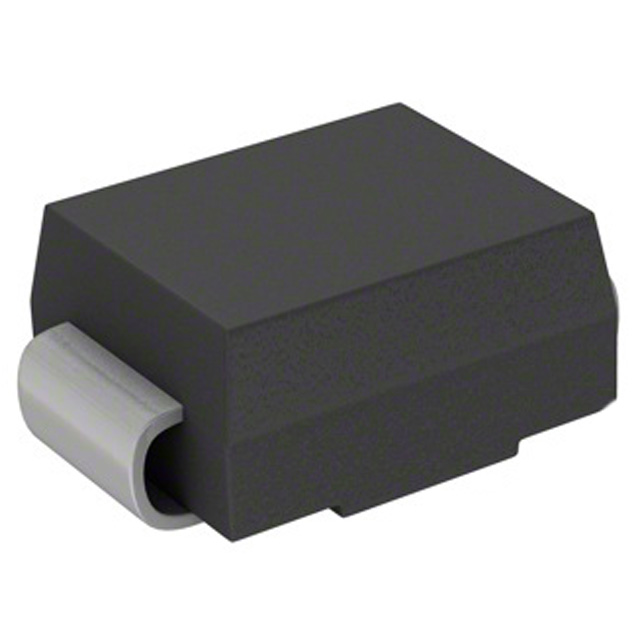
Package / Case
Package / Case refers to the physical housing or enclosure that encapsulates an electronic component. It provides protection, facilitates handling, and enables electrical connections. The package type determines the component's size, shape, pin configuration, and mounting options. Common package types include DIP (dual in-line package), SOIC (small outline integrated circuit), and BGA (ball grid array). The package also influences the component's thermal and electrical performance.
DO-214AA, SMB
Number of Pins
Number of Pins: Indicates the number of electrical connections available on the component. These pins are used to connect the component to other components or circuits on a printed circuit board (PCB). The number of pins determines the functionality and connectivity options of the component. It is important to ensure that the component has the correct number of pins for the intended application.
2
Packaging
Tape & Reel (TR)
Series
Series, in the context of electronic components, refers to the arrangement of components in a circuit. When components are connected in series, they form a single path for current to flow through. The total resistance of a series circuit is the sum of the individual resistances of each component. Series connections are often used to control the flow of current in a circuit, as the total resistance can be adjusted by changing the number or type of components in the series.
SIDACtor®
Part Status
Part Status is an electronic component parameter that indicates the availability and production status of a component. It is typically used to inform customers about the availability of a component, whether it is in production, end-of-life, or obsolete. Part Status can also provide information about any restrictions or limitations on the component's use, such as whether it is only available for certain applications or if it has been discontinued.
Active
Moisture Sensitivity Level (MSL)
Moisture Sensitivity Level (MSL) is a measure of the susceptibility of a surface mount electronic component to moisture-induced damage during soldering. It is classified into six levels, from 1 (least sensitive) to 6 (most sensitive). MSL is determined by the materials used in the component's construction, including the solderability of its terminals and the presence of moisture-absorbing materials. Components with higher MSL ratings require more stringent handling and storage conditions to prevent moisture absorption and subsequent damage during soldering.
1 (Unlimited)
Terminal Finish
Matte Tin (Sn)
Max Operating Temperature
85°C
Min Operating Temperature
-40°C
Additional Feature
UL RECOGNIZED
Capacitance
Capacitance is the ability of a component to store electrical charge. It is measured in farads (F). A capacitor is a passive electronic component that consists of two conductors separated by an insulator. When a voltage is applied across the capacitor, charge builds up on the conductors. The amount of charge that can be stored depends on the capacitance of the capacitor. Capacitors are used in a variety of electronic circuits, including filters, timing circuits, and energy storage devices.
60pF
Subcategory
Silicon Surge Protectors
Peak Reflow Temperature (Cel)
260
Reach Compliance Code
not_compliant
Current Rating
Current Rating is the maximum amount of current that an electronic component can safely handle without overheating or failing. It is typically expressed in amperes (A) or milliamperes (mA). Exceeding the current rating can damage the component and potentially create a safety hazard. The current rating is determined by the physical characteristics of the component, such as its size, material, and construction.
2.2A
Time@Peak Reflow Temperature-Max (s)
30
Qualification Status
Not Qualified
Current - Peak Pulse (10/1000μs)
80A
Trigger Device Type
SILICON SURGE PROTECTOR
RoHS Status
ROHS3 Compliant
P1300SBLRP OverviewThe product in question is a part by the brand Littelfuse Inc., specifically from the TVS - Thyristors category. The JESD-609 Code for this component is e3, and it has a minimum operating temperature of -40°C. The capacitance measures 60pF, but it does not comply with the reach compliance code. The current rating stands at 2.2A, with a pin count of 2. The hold current capacity is 150mA, and the trigger device type is a Silicon Surge Protector. In terms of voltage, the product's voltage when off state is 120V, while it is 4V when on state.
P1300SBLRP More Descriptions
Thyristor Surge Protection Devices 120V 30A 2-Pin DO-214AA T/R / SIDACTOR BI 120V 250A DO214
pxxx0s_ Series - DO-214AA SIDACtor® Device, 120V, RoHSLittelfuse SCT
T&r/Protection Thyristor/Sidactor Bi 120V 100A Do214 2L Rohs Rohs Compliant: Yes |Littelfuse P1300SBLRP
French Electronic Distributor since 1988
FIXED IND 4.7UH 780MA 228 MOHM