Mounting Type
Mounting Type refers to the method by which an electronic component is attached to a printed circuit board (PCB) or other surface. Common mounting types include:
* Through-hole: Component leads are inserted into holes in the PCB and soldered on the other side.
* Surface-mount: Component is placed on the surface of the PCB and soldered in place.
* Press-fit: Component is pressed into place on the PCB without soldering.
* Socket: Component is inserted into a socket on the PCB, allowing for easy replacement.
The mounting type is determined by factors such as the component's size, shape, and power requirements.
Surface Mount
Package / Case
Package / Case refers to the physical housing or enclosure that encapsulates an electronic component. It provides protection, facilitates handling, and enables electrical connections. The package type determines the component's size, shape, pin configuration, and mounting options. Common package types include DIP (dual in-line package), SOIC (small outline integrated circuit), and BGA (ball grid array). The package also influences the component's thermal and electrical performance.
44-TQFP
Operating Temperature
Operating Temperature is the range of temperatures at which an electronic component can function properly. It is typically specified in degrees Celsius (°C) and indicates the minimum and maximum temperatures at which the component can operate without experiencing damage or degradation. Operating Temperature is an important parameter to consider when designing electronic circuits, as it ensures that the components will function reliably in the intended operating environment.
-40°C~85°C TA
Packaging
Tape & Reel (TR)
Series
Series, in the context of electronic components, refers to the arrangement of components in a circuit. When components are connected in series, they form a single path for current to flow through. The total resistance of a series circuit is the sum of the individual resistances of each component. Series connections are often used to control the flow of current in a circuit, as the total resistance can be adjusted by changing the number or type of components in the series.
Automotive, AEC-Q100, PIC® XLP™ 16F
Part Status
Part Status is an electronic component parameter that indicates the availability and production status of a component. It is typically used to inform customers about the availability of a component, whether it is in production, end-of-life, or obsolete. Part Status can also provide information about any restrictions or limitations on the component's use, such as whether it is only available for certain applications or if it has been discontinued.
Active
Moisture Sensitivity Level (MSL)
Moisture Sensitivity Level (MSL) is a measure of the susceptibility of a surface mount electronic component to moisture-induced damage during soldering. It is classified into six levels, from 1 (least sensitive) to 6 (most sensitive). MSL is determined by the materials used in the component's construction, including the solderability of its terminals and the presence of moisture-absorbing materials. Components with higher MSL ratings require more stringent handling and storage conditions to prevent moisture absorption and subsequent damage during soldering.
1 (Unlimited)
Number of Terminations
44
Terminal Finish
Matte Tin (Sn)
Additional Feature
ALSO OPERATES AT 2.3 V MINIMUM SUPPLY AT 16 MHZ
Technology
Technology, in the context of electronic components, refers to the specific manufacturing process and materials used to create the component. It encompasses the semiconductor fabrication techniques, such as the type of transistor used (e.g., MOSFET, BJT), the gate oxide thickness, and the interconnect materials. Technology also includes the packaging type, such as surface mount or through-hole, and the leadframe or substrate material. The technology used impacts the component's performance characteristics, such as speed, power consumption, and reliability.
CMOS
Peak Reflow Temperature (Cel)
260
Supply Voltage
Supply Voltage is the voltage required to power an electronic component. It is typically measured in volts (V) and is specified in the component's datasheet. The supply voltage must be within the specified range for the component to function properly. If the supply voltage is too low, the component may not function at all. If the supply voltage is too high, the component may be damaged.
3V
Reach Compliance Code
compliant
Time@Peak Reflow Temperature-Max (s)
30
Supply Voltage-Max (Vsup)
5.5V
Supply Voltage-Min (Vsup)
2.5V
Speed
Speed, in the context of electronic components, refers to the rate at which the component can process or transmit data. It is typically measured in units of bits per second (bps), megabits per second (Mbps), or gigabits per second (Gbps). The speed of a component is determined by its internal design and the technology used to manufacture it. Faster components can handle more data in a given amount of time, which can improve the overall performance of a system.
32MHz
Voltage - Supply (Vcc/Vdd)
2.3V~5.5V
uPs/uCs/Peripheral ICs Type
MICROCONTROLLER, RISC
Core Processor
Core Processor refers to the central processing unit (CPU) of an electronic device. It is the brain of the device, responsible for executing instructions, processing data, and managing the overall operation of the system. The core processor's speed, number of cores, and architecture determine the device's performance and capabilities.
PIC
Peripherals
Brown-out Detect/Reset, POR, PWM, WDT
Clock Frequency
Clock Frequency, measured in Hertz (Hz), is the rate at which an electronic component, such as a microprocessor or oscillator, generates electrical pulses. It determines the speed at which the component can process data and execute instructions. A higher clock frequency generally indicates faster performance, but also higher power consumption and heat generation. Clock Frequency is a crucial parameter for timing-sensitive applications, such as digital signal processing and real-time systems.
32MHz
Program Memory Type
FLASH
Core Size
Core Size refers to the physical dimensions of the magnetic core used in an electronic component, such as an inductor or transformer. It is typically expressed in terms of its length, width, and height, or as a diameter and height for cylindrical cores. The core size determines the inductance, current-carrying capacity, and other electrical characteristics of the component. Larger core sizes generally result in higher inductance and current-handling capabilities.
8-Bit
Program Memory Size
28KB 16K x 14
Connectivity
Connectivity refers to the number of terminals or pins on an electronic component that allow it to connect to other components in a circuit. It determines the component's ability to interact and exchange signals with other elements in the system. Higher connectivity indicates more connection points, enabling the component to perform complex functions and integrate with various circuits.
I2C, LINbus, SPI, UART/USART
Data Converter
A/D 35x10b; D/A 1x5b
On Chip Program ROM Width
14
Length
Length, in the context of electronic components, refers to the physical dimension of a component along its longest axis. It is typically measured in millimeters (mm) or inches (in). Length is a crucial parameter for determining the physical size and space requirements of a component on a printed circuit board (PCB) or other assembly. It also affects the component's electrical characteristics, such as inductance and capacitance, which can be influenced by the length of conductors or traces within the component.
10mm
Height Seated (Max)
1.2mm
RoHS Status
RoHS Compliant
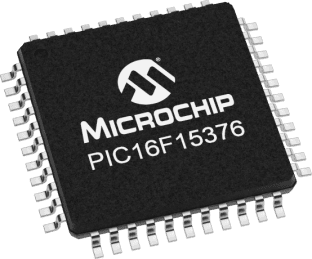
PIC16F15376T-I/PTVAO Overview
Packaged in a 44-TQFP format. A total of 36 I/Os are on the Microcontroller. Surface Mount is the mounting type of the Microcontroller that is attached to the panel. This Microcontroller is based on a core called 8-Bit. The type of its program memory is FLASH. In this Microcontroller, temperature is controlled within the range -40°C~85°C TA. A Automotive, AEC-Q100, PIC® XLP™ 16F series electrical component is used in this application. This program has a program memory of 28KB 16K x 14 bytes, which is the size of the program. With a PIC Core Processor, Microcontroller is fast and efficient. ICs for MICROCONTROLLER, RISC uPs/uCs/peripheral parts. There are 44 terminations on the IC chip, which means there are 44 terminations on the integrated circuit chip. In addition, MCU chip comes with a 8-bit size. Microcontroller chip has outputs of 3V volts. The system has NO channels for DMA communication. This MCU Chip uses YES PWM channels to operate. The PIC CPU family is embedded in the device, so it can handle a wide range of operations. It runs on a 32MHz clock. As an example, one of the additional features that you can use is ALSO OPERATES AT 2.3 V MINIMUM SUPPLY AT 16 MHZ. An integrated circuit with 2 bits has a total of 2 bits.
PIC16F15376T-I/PTVAO Features
44-TQFP package
Mounting type of Surface Mount
PIC16F15376T-I/PTVAO Applications
There are a lot of Microchip Technology
PIC16F15376T-I/PTVAO Microcontroller applications.
Radio
Television
Heater/Fan
Calculator
Kindle
Christmas lights
3D printers
Washing machine
Microwave ovens
Home appliances
PIC16F15376T-I/PTVAO More Descriptions
8-bit PIC MCU, 28 KB, 2048 Bytes, 32 MHz, 1.8 to 5.5V, TQFP-44, RoHSMicrochip SCT
28KB 2KB RAM 38x I/O 4xPWMs Comp DAC ADC CWG 2xEUSART 2xSPI/I2C
IC MCU 8BIT 28KB FLASH 44TQFP