Factory Lead Time
6 Weeks
Lifecycle Status
ACTIVE (Last Updated: 3 days ago)
Mounting Type
Mounting Type refers to the method by which an electronic component is attached to a printed circuit board (PCB) or other surface. Common mounting types include:
* Through-hole: Component leads are inserted into holes in the PCB and soldered on the other side.
* Surface-mount: Component is placed on the surface of the PCB and soldered in place.
* Press-fit: Component is pressed into place on the PCB without soldering.
* Socket: Component is inserted into a socket on the PCB, allowing for easy replacement.
The mounting type is determined by factors such as the component's size, shape, and power requirements.
Surface Mount
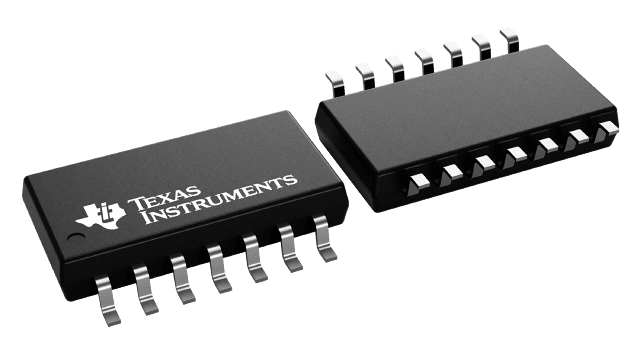
Package / Case
Package / Case refers to the physical housing or enclosure that encapsulates an electronic component. It provides protection, facilitates handling, and enables electrical connections. The package type determines the component's size, shape, pin configuration, and mounting options. Common package types include DIP (dual in-line package), SOIC (small outline integrated circuit), and BGA (ball grid array). The package also influences the component's thermal and electrical performance.
14-SOIC (0.209, 5.30mm Width)
Number of Pins
Number of Pins: Indicates the number of electrical connections available on the component. These pins are used to connect the component to other components or circuits on a printed circuit board (PCB). The number of pins determines the functionality and connectivity options of the component. It is important to ensure that the component has the correct number of pins for the intended application.
14
Operating Temperature
Operating Temperature is the range of temperatures at which an electronic component can function properly. It is typically specified in degrees Celsius (°C) and indicates the minimum and maximum temperatures at which the component can operate without experiencing damage or degradation. Operating Temperature is an important parameter to consider when designing electronic circuits, as it ensures that the components will function reliably in the intended operating environment.
-40°C~125°C
Packaging
Tape & Reel (TR)
Series
Series, in the context of electronic components, refers to the arrangement of components in a circuit. When components are connected in series, they form a single path for current to flow through. The total resistance of a series circuit is the sum of the individual resistances of each component. Series connections are often used to control the flow of current in a circuit, as the total resistance can be adjusted by changing the number or type of components in the series.
74LVC
Part Status
Part Status is an electronic component parameter that indicates the availability and production status of a component. It is typically used to inform customers about the availability of a component, whether it is in production, end-of-life, or obsolete. Part Status can also provide information about any restrictions or limitations on the component's use, such as whether it is only available for certain applications or if it has been discontinued.
Active
Moisture Sensitivity Level (MSL)
Moisture Sensitivity Level (MSL) is a measure of the susceptibility of a surface mount electronic component to moisture-induced damage during soldering. It is classified into six levels, from 1 (least sensitive) to 6 (most sensitive). MSL is determined by the materials used in the component's construction, including the solderability of its terminals and the presence of moisture-absorbing materials. Components with higher MSL ratings require more stringent handling and storage conditions to prevent moisture absorption and subsequent damage during soldering.
1 (Unlimited)
Number of Terminations
14
Technology
Technology, in the context of electronic components, refers to the specific manufacturing process and materials used to create the component. It encompasses the semiconductor fabrication techniques, such as the type of transistor used (e.g., MOSFET, BJT), the gate oxide thickness, and the interconnect materials. Technology also includes the packaging type, such as surface mount or through-hole, and the leadframe or substrate material. The technology used impacts the component's performance characteristics, such as speed, power consumption, and reliability.
CMOS
Voltage - Supply
1.65V~3.6V
Peak Reflow Temperature (Cel)
260
Supply Voltage
Supply Voltage is the voltage required to power an electronic component. It is typically measured in volts (V) and is specified in the component's datasheet. The supply voltage must be within the specified range for the component to function properly. If the supply voltage is too low, the component may not function at all. If the supply voltage is too high, the component may be damaged.
1.8V
Number of Outputs
Number of Outputs refers to the number of independent output signals or channels that an electronic component can provide. It indicates the capability of the component to drive multiple external devices or circuits simultaneously. A higher number of outputs allows for greater flexibility and connectivity in electronic systems.
1
Supply Voltage-Max (Vsup)
3.6V
Load Capacitance
Load Capacitance (CL) is a parameter that specifies the maximum capacitance that can be connected to the output of an electronic component without affecting its performance. It is typically measured in picofarads (pF) or nanofarads (nF). A high load capacitance can cause the output voltage to drop or the output current to increase, which can lead to instability or damage to the component.
50pF
Output Current
Output Current is the maximum amount of current that an electronic component can deliver to a load without exceeding its specified operating limits. It is typically measured in amperes (A) or milliamperes (mA). Output Current is a critical parameter for selecting electronic components, as it determines the amount of power that the component can provide to a load.
24mA
Quiescent Current
Quiescent current is the amount of current drawn by an electronic component when it is not actively performing its intended function. It is typically measured in milliamps (mA) or microamps (µA). Quiescent current is important because it can affect the overall power consumption of a circuit, especially in battery-powered devices. Components with high quiescent current can drain batteries more quickly than those with low quiescent current.
1μA
Turn On Delay Time
3.8 ns
Number of Inputs
The number of inputs of an electronic component refers to the number of separate signals or data streams that the component can receive and process simultaneously. It indicates the maximum number of external connections that can be made to the component to provide input signals. This parameter is crucial for determining the functionality and connectivity of the component within a circuit or system.
2
Current - Output High, Low
24mA 24mA
Logic Type
Logic Type refers to the type of logic implemented by an electronic component, such as a logic gate or flip-flop.
OR Gate
Max Propagation Delay @ V, Max CL
3.6ns @ 3.3V, 50pF
Logic Level - Low
0.7V ~ 0.8V
Logic Level - High
Logic Level - High refers to the voltage level that represents a logical "1" in a digital circuit. It is typically defined as a voltage range that is higher than a specified threshold voltage. The specific value of the Logic Level - High depends on the logic family being used, such as TTL, CMOS, or ECL. For example, in TTL logic, the Logic Level - High is typically defined as a voltage between 2.4V and 5V.
1.7V ~ 2V
Height
Height, in the context of electronic components, refers to the vertical dimension of the component. It is typically measured in millimeters (mm) or inches (in). Height is an important parameter to consider when designing and assembling electronic circuits, as it affects the overall size and form factor of the device. Components with a smaller height are often preferred for applications where space is limited, such as in portable devices or embedded systems.
2mm
Length
Length, in the context of electronic components, refers to the physical dimension of a component along its longest axis. It is typically measured in millimeters (mm) or inches (in). Length is a crucial parameter for determining the physical size and space requirements of a component on a printed circuit board (PCB) or other assembly. It also affects the component's electrical characteristics, such as inductance and capacitance, which can be influenced by the length of conductors or traces within the component.
10.3mm
Thickness
Thickness, in the context of electronic components, refers to the vertical distance between two opposing surfaces of a component. It is typically measured in millimeters (mm) or inches (in). Thickness is a crucial parameter that affects the component's physical dimensions, weight, and performance characteristics. It influences factors such as heat dissipation, electrical insulation, and mechanical stability. Thinner components generally offer better heat dissipation and space efficiency, while thicker components may provide enhanced durability and structural integrity.
1.95mm
RoHS Status
ROHS3 Compliant
Description
The SN54LVC32A quadruple 2-input positive-OR gate is designed for 2.7V to 3.6V Vcc operation, and the SN74LVC32A quadruple 2-input positive-OR gate is designed for 1.65V to 3.6V Vcc operation. The SNX4LVC32A devices perform the Boolean function Y = A B or Y - A • B in positive logic. Inputs can be driven from either 3.3V or 5V devices. This feature allows the use of these devices as translators in a mixed 3.3V/5V system environment.
Features
Operate from 1.65V to 3.6V
Specified from -40°C to 85°C, -40°C to 125°C, and -55°C to 125°C
Inputs accept voltages to 5.5V
Max tod of 3.8ns at 3.3V
Typical VOLP (output ground bounce) <0.8V at Vcc 3.3V, TA = 25°C
Typical VOHV (output Voч undershoot) >2V at Vcc 3.3V, TA = 25°C
Latch-up performance exceeds 250mA per JESD 17
ESD protection exceeds JESD 22
2000V human-body model
1000V charged-device model
Applications
AV Receivers
Audio Docks: Portable
Blu-ray Players and Home Theater
MP3 Players or Recorders
Personal Digital Assistant (PDA)
Power: Telecom/Server AC/DC Supply: Single
Controller: Analog and Digital
Solid State Drives (SSDs): Client and Enterprise
TVs: LCD, Digital, and High-Definition (HDTV)
Tablets: Enterprise
Video Analytics: Server
Wireless Headsets, Keyboards, and Mice