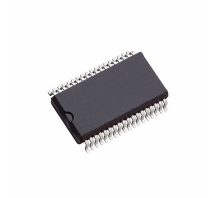
Mounting Type
Mounting Type refers to the method by which an electronic component is attached to a printed circuit board (PCB) or other surface. Common mounting types include:
* Through-hole: Component leads are inserted into holes in the PCB and soldered on the other side.
* Surface-mount: Component is placed on the surface of the PCB and soldered in place.
* Press-fit: Component is pressed into place on the PCB without soldering.
* Socket: Component is inserted into a socket on the PCB, allowing for easy replacement.
The mounting type is determined by factors such as the component's size, shape, and power requirements.
Surface Mount
Package / Case
Package / Case refers to the physical housing or enclosure that encapsulates an electronic component. It provides protection, facilitates handling, and enables electrical connections. The package type determines the component's size, shape, pin configuration, and mounting options. Common package types include DIP (dual in-line package), SOIC (small outline integrated circuit), and BGA (ball grid array). The package also influences the component's thermal and electrical performance.
36-BSOP (0.295, 7.50mm Width)
Number of Pins
Number of Pins: Indicates the number of electrical connections available on the component. These pins are used to connect the component to other components or circuits on a printed circuit board (PCB). The number of pins determines the functionality and connectivity options of the component. It is important to ensure that the component has the correct number of pins for the intended application.
36
Part Status
Part Status is an electronic component parameter that indicates the availability and production status of a component. It is typically used to inform customers about the availability of a component, whether it is in production, end-of-life, or obsolete. Part Status can also provide information about any restrictions or limitations on the component's use, such as whether it is only available for certain applications or if it has been discontinued.
Obsolete
Moisture Sensitivity Level (MSL)
Moisture Sensitivity Level (MSL) is a measure of the susceptibility of a surface mount electronic component to moisture-induced damage during soldering. It is classified into six levels, from 1 (least sensitive) to 6 (most sensitive). MSL is determined by the materials used in the component's construction, including the solderability of its terminals and the presence of moisture-absorbing materials. Components with higher MSL ratings require more stringent handling and storage conditions to prevent moisture absorption and subsequent damage during soldering.
1 (Unlimited)
Number of Terminations
36
Terminal Finish
MATTE TIN
Max Operating Temperature
85°C
Min Operating Temperature
-40°C
Peak Reflow Temperature (Cel)
260
Supply Voltage
Supply Voltage is the voltage required to power an electronic component. It is typically measured in volts (V) and is specified in the component's datasheet. The supply voltage must be within the specified range for the component to function properly. If the supply voltage is too low, the component may not function at all. If the supply voltage is too high, the component may be damaged.
3V
Reach Compliance Code
unknown
Reflow Temperature-Max (s)
40
Base Part Number
TRAC020LH
Qualification Status
Not Qualified
Supply Voltage-Max (Vsup)
3.15V
Temperature Grade
INDUSTRIAL
Supply Voltage-Min (Vsup)
2.85V
Neg Supply Voltage-Nom (Vsup)
-2V
Neg Supply Voltage-Max (Vsup)
-2.1V
Neg Supply Voltage-Min (Vsup)
-1.9V
Height Seated (Max)
2.64mm
Length
Length, in the context of electronic components, refers to the physical dimension of a component along its longest axis. It is typically measured in millimeters (mm) or inches (in). Length is a crucial parameter for determining the physical size and space requirements of a component on a printed circuit board (PCB) or other assembly. It also affects the component's electrical characteristics, such as inductance and capacitance, which can be influenced by the length of conductors or traces within the component.
15.3mm
RoHS Status
Non-RoHS Compliant
Description
The TRAC020LH is a Micro-Power version of the existing TRAC products, offering significant improvements in bandwidth and function accuracy. It is a highly flexible single-chip solution for signal processing problems in various markets. TRAC020LH enables rapid implementation, prototyping, and product release through a Top-Down, Structured design discipline. It provides designers with benefits formerly associated with programmable digital devices, allowing them to stay focused on analog problems mathematically with minimal circuit design.
Features and Benefits
Faster design and verification of signal processing solutions
Instant working silicon
Flexibility to react to changing requirements
Computational Approach for analog problem-solving
Just as versatile as FPGA and easy to use
Completes more projects on time
High level of integration and design secrecy
Integration with other CAE systems
Transparent design migration to semi-custom and future devices
Less than 8 bytes to program
Full industrial temperature range
Standby mode for improved battery life
Devices easily cascaded for more complex designs
Combines silicon, software, and support
Applications
Analog Computation
Analog Signal Processing (ASP)
Classical & Modern Control Systems
Audio Applications
Sonar and Ultrasonic Systems
Log, Linear, and Modern Filter Design
Instrumentation
Transducer Characteristic Correction
Vector Analysis
Analog Correlation
Echo Cancellation