Factory Lead Time
17 Weeks
Mounting Type
Mounting Type refers to the method by which an electronic component is attached to a printed circuit board (PCB) or other surface. Common mounting types include:
* Through-hole: Component leads are inserted into holes in the PCB and soldered on the other side.
* Surface-mount: Component is placed on the surface of the PCB and soldered in place.
* Press-fit: Component is pressed into place on the PCB without soldering.
* Socket: Component is inserted into a socket on the PCB, allowing for easy replacement.
The mounting type is determined by factors such as the component's size, shape, and power requirements.
Surface Mount
Package / Case
Package / Case refers to the physical housing or enclosure that encapsulates an electronic component. It provides protection, facilitates handling, and enables electrical connections. The package type determines the component's size, shape, pin configuration, and mounting options. Common package types include DIP (dual in-line package), SOIC (small outline integrated circuit), and BGA (ball grid array). The package also influences the component's thermal and electrical performance.
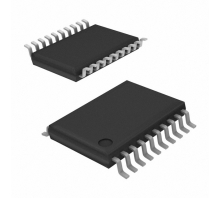
20-TSSOP (0.173, 4.40mm Width)
Operating Temperature
Operating Temperature is the range of temperatures at which an electronic component can function properly. It is typically specified in degrees Celsius (°C) and indicates the minimum and maximum temperatures at which the component can operate without experiencing damage or degradation. Operating Temperature is an important parameter to consider when designing electronic circuits, as it ensures that the components will function reliably in the intended operating environment.
-40°C~85°C
Series
Series, in the context of electronic components, refers to the arrangement of components in a circuit. When components are connected in series, they form a single path for current to flow through. The total resistance of a series circuit is the sum of the individual resistances of each component. Series connections are often used to control the flow of current in a circuit, as the total resistance can be adjusted by changing the number or type of components in the series.
XDCP™
Tolerance
Tolerance in electronic components refers to the allowable deviation from the specified value. It indicates the range within which the actual value of the component can vary while still meeting the manufacturer's specifications. Tolerance is typically expressed as a percentage of the nominal value, such as ±5% or ±10%. A lower tolerance indicates a tighter range of acceptable values, resulting in more precise and consistent performance.
±20%
Feature
Selectable Address
Part Status
Part Status is an electronic component parameter that indicates the availability and production status of a component. It is typically used to inform customers about the availability of a component, whether it is in production, end-of-life, or obsolete. Part Status can also provide information about any restrictions or limitations on the component's use, such as whether it is only available for certain applications or if it has been discontinued.
Active
Moisture Sensitivity Level (MSL)
Moisture Sensitivity Level (MSL) is a measure of the susceptibility of a surface mount electronic component to moisture-induced damage during soldering. It is classified into six levels, from 1 (least sensitive) to 6 (most sensitive). MSL is determined by the materials used in the component's construction, including the solderability of its terminals and the presence of moisture-absorbing materials. Components with higher MSL ratings require more stringent handling and storage conditions to prevent moisture absorption and subsequent damage during soldering.
3 (168 Hours)
Number of Terminations
20
Temperature Coefficient
Temperature Coefficient (TC) measures the relative change in a component's value due to temperature variations. It is expressed as a percentage change per degree Celsius (°C). A positive TC indicates an increase in value with increasing temperature, while a negative TC indicates a decrease. TC is crucial for ensuring stable circuit performance over a range of temperatures. It helps designers compensate for temperature-induced changes and maintain desired component characteristics.
300 ppm/°C
Resistance
Resistance is a measure of the opposition to the flow of electric current in a conductor. It is measured in ohms (Ω). The higher the resistance, the more difficult it is for current to flow. Resistance is caused by the collisions of electrons with atoms and molecules in the conductor. The more collisions that occur, the higher the resistance.
50kOhm
Number of Positions
Number of Positions, in the context of electronic components, refers to the number of distinct terminals or connection points available on the component. It indicates the number of individual electrical connections that can be made to the component. A higher number of positions typically allows for more complex functionality and versatility in circuit design.
64
Terminal Finish
MATTE TIN
Additional Feature
REST 3 RESISTOR ARRAY VALUES ARE : 50000 OHMS
Technology
Technology, in the context of electronic components, refers to the specific manufacturing process and materials used to create the component. It encompasses the semiconductor fabrication techniques, such as the type of transistor used (e.g., MOSFET, BJT), the gate oxide thickness, and the interconnect materials. Technology also includes the packaging type, such as surface mount or through-hole, and the leadframe or substrate material. The technology used impacts the component's performance characteristics, such as speed, power consumption, and reliability.
CMOS
Peak Reflow Temperature (Cel)
NOT SPECIFIED
Supply Voltage
Supply Voltage is the voltage required to power an electronic component. It is typically measured in volts (V) and is specified in the component's datasheet. The supply voltage must be within the specified range for the component to function properly. If the supply voltage is too low, the component may not function at all. If the supply voltage is too high, the component may be damaged.
5V
Reflow Temperature-Max (s)
NOT SPECIFIED
Configuration
Potentiometer
Interface
In electronics, an interface refers to the connection point or boundary between two or more electronic systems or devices. It defines the physical, electrical, and logical characteristics that enable communication and data exchange between them.
An interface specifies the protocols, pinouts, voltage levels, data formats, and other parameters necessary for the systems to interact seamlessly. It ensures compatibility and interoperability between different components or devices, allowing them to exchange information and perform their intended functions.
I2C
Number of Circuits
Number of Circuits refers to the number of independent signal paths within an electronic component. It indicates how many separate circuits or channels the component can handle simultaneously. For example, an operational amplifier with a Number of Circuits of 2 can amplify two separate input signals independently. This parameter is crucial for determining the component's functionality and its suitability for specific applications.
4
Memory Type
Memory Type refers to the type of memory technology used in an electronic device. It indicates the specific design and architecture of the memory, such as DRAM (Dynamic Random Access Memory), SRAM (Static Random Access Memory), ROM (Read-Only Memory), EEPROM (Electrically Erasable Programmable Read-Only Memory), or Flash memory. Each memory type has unique characteristics, including speed, capacity, volatility, and cost, which determine its suitability for different applications.
Non-Volatile
Number of Taps
Number of Taps refers to the number of connections or terminals available on a transformer or inductor. Each tap provides access to a different voltage level or impedance point within the component. By connecting to different taps, the user can adjust the output voltage or impedance to suit their specific application. The number of taps available determines the flexibility and versatility of the component.
64
Total Resistance
50000Ohm
Resistance - Wiper (Ω) (Typ)
40
Resistor Terminal Voltage-Max
5V
Temperature Coefficient (Typ)
±300ppm/°C
Resistor Terminal Voltage-Min
-3V
Height Seated (Max)
1.2mm
Length
Length, in the context of electronic components, refers to the physical dimension of a component along its longest axis. It is typically measured in millimeters (mm) or inches (in). Length is a crucial parameter for determining the physical size and space requirements of a component on a printed circuit board (PCB) or other assembly. It also affects the component's electrical characteristics, such as inductance and capacitance, which can be influenced by the length of conductors or traces within the component.
6.5mm
RoHS Status
ROHS3 Compliant
X9241AUVIZ Overview
This component is manufactured by Intersil and falls under the category of Data Acquisition - Digital Potentiometers. It is specifically a chip used for this purpose, and its packaging is in a tube. The series name is XDCP™ and it has a Moisture Sensitivity Level (MSL) of 3, meaning it can withstand up to 168 hours of exposure to moisture. It has a total of 20 terminations and its terminal finish is matte tin. The terminal position is dual, and the peak reflow temperature is not specified. The supply voltage for this chip is 5V and its configuration is as a potentiometer. The typical temperature coefficient is ±300ppm/°C.
X9241AUVIZ Features
Available in 20-TSSOP (0.173, 4.40mm Width) package
4 Circuits
Mounting Type: Surface Mount
Operate temperature at the range of -40°C~85°C
X9241AUVIZ Applications
There are a lot of Renesas Electronics America Inc. X9241AUVIZ Digital Potentiometers applications.
Used as variable resistor
Refrigerator
DC/DC conversion circuit
Cell phone
Automotive electronics
Stereo
DAC
Motor control
Programmable voltage regulator
Adjusting the LCD Display
X9241AUVIZ More Descriptions
Ic,digital Potentiometer,cmos,tssop,20Pin,plastic Rohs Compliant: Yes |Renesas X9241AUVIZ
Quad Digital Controlled Potentiometers (XDCP™), Non-Volatile/Low Power/2-Wire/64 Taps
TEXAS INSTRUMENTS RCV420KP IC, CURRENT LOOP RECEIVER, 3mA, 16-DIP
Digital Potentiometer 64POS 50k Ohm Quad 20-Pin TSSOP Tube
IC DGTL POT 50KOHM 64TAP 20TSSOP
IC XDCP QUAD 4X50K EE 20-TSSOP
$ Four potentiometers in one package $ 2-wire serial interface $ Register oriented format $$ Direct read/write/transfer of wiper positions $$ Store as many as four positions per potentiometer $ Terminal Voltages: 5V, -3.0V $ Cascade resistor arrays $ Low power CMOS $ High Reliability $$ Endurance-100,000 data changes per bit per register $$ Register data retention-100 years $ 16-bytes of nonvolatile memory $ 3 resistor array values $$ 2kΩ, 10kΩ, 50kΩ or combination $$ Cascadable for values of 4kΩ to 200kΩ $ Resolution: 64 taps each pot $ 20 Ld plastic DIP, 20 Ld TSSOP and 20 Ld SOIC packages $ Pb-free available (RoHS compliant)