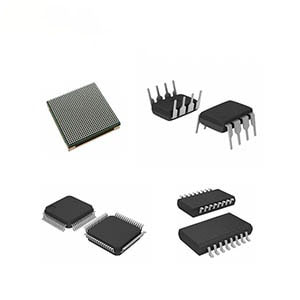
Package / Case
Package / Case refers to the physical housing or enclosure that encapsulates an electronic component. It provides protection, facilitates handling, and enables electrical connections. The package type determines the component's size, shape, pin configuration, and mounting options. Common package types include DIP (dual in-line package), SOIC (small outline integrated circuit), and BGA (ball grid array). The package also influences the component's thermal and electrical performance.
MSOP
Number of Pins
Number of Pins: Indicates the number of electrical connections available on the component. These pins are used to connect the component to other components or circuits on a printed circuit board (PCB). The number of pins determines the functionality and connectivity options of the component. It is important to ensure that the component has the correct number of pins for the intended application.
8
Resistance
Resistance is a measure of the opposition to the flow of electric current in a conductor. It is measured in ohms (Ω). The higher the resistance, the more difficult it is for current to flow. Resistance is caused by the collisions of electrons with atoms and molecules in the conductor. The more collisions that occur, the higher the resistance.
500MOhm
Max Operating Temperature
70°C
Min Operating Temperature
0°C
Number of Channels
Number of Channels refers to the number of independent signal paths within an electronic component. It indicates how many separate signals can be processed or transmitted simultaneously. For example, an audio amplifier with two channels can amplify two separate audio signals, while a multi-channel data converter can convert multiple analog signals into digital data. The number of channels is a crucial parameter for determining the component's functionality and application.
1
Number of Circuits
Number of Circuits refers to the number of independent signal paths within an electronic component. It indicates how many separate circuits or channels the component can handle simultaneously. For example, an operational amplifier with a Number of Circuits of 2 can amplify two separate input signals independently. This parameter is crucial for determining the component's functionality and its suitability for specific applications.
1
Operating Supply Current
Operating Supply Current is the amount of current drawn by an electronic component when it is operating under normal conditions. It is typically measured in milliamps (mA) or microamps (µA). The operating supply current is important because it can affect the power consumption of the component and the overall system. A higher operating supply current will result in higher power consumption, which can lead to overheating and reduced battery life.
700μA
Slew Rate
Slew rate is a measure of how quickly an electronic component's output voltage can change in response to a change in its input voltage. It is typically expressed in volts per microsecond (V/µs). A higher slew rate indicates that the component can respond more quickly to changes in its input voltage, which can be important in applications where fast signal processing is required.
0.75 V/μs
Common Mode Rejection Ratio
69 dB
Output Current per Channel
30mA
Input Offset Voltage (Vos)
Input Offset Voltage (Vos) is a parameter that specifies the voltage difference between the non-inverting and inverting inputs of an operational amplifier (op-amp) when the output voltage is zero. It represents the amount of voltage that must be applied to the inputs to bring the output to zero. Vos is caused by mismatches in the internal transistors of the op-amp and can vary with temperature and other factors. A low Vos is desirable for precision applications where accurate signal processing is required.
250μV
Gain Bandwidth Product
3.2MHz
Power Supply Rejection Ratio (PSRR)
75dB
Max Dual Supply Voltage
5.5V
Min Dual Supply Voltage
1.35V
Nominal Gain Bandwidth Product
4MHz
RoHS Status
RoHS Compliant
LTC1992CMS8 Overview
In the package, you will find a MSOP-case to contain the op amp ic. The op amp ic has an array of 8 pins on it. Op amp rates 250μV as input offset voltage. Using an 700μA supply current, this operational amplifier ics can be operated. You should keep the voltage gain at 80dB for the time being. A instrumentation amplifier like this has 1 circuits. On the buffer amps, there are 1 channels that can be used. To operate this buffer amplifier, the temperature must not be lower than 0°C. A temperature greater than 70°C should not be used for the operation of buffer amplifier. 1 elements make up the design of this buffer amplifier. This electric component can work from a voltage of under 12V as far as supply voltage is concerned. A voltage of 2.4V or higher is recommended for the linear amplifier's supply voltage. This electrical part should be conducted under the dual supply voltage of 5.5V volts when you conduct this part. During testing, the instrumentation amplifier resistance should remain within a range of 500MOhm.
LTC1992CMS8 Features
80dB voltage gain
Resistance of 500MOhm
LTC1992CMS8 Applications
There are a lot of Analog Devices, Inc.
LTC1992CMS8 Instrumentational OP Amps applications.
Multiplication circuits
Division circuits
Precision measurement
Power control
Information processing
Weak signal detection
Signal amplification
Signal filtering
Signal operation
Video computer boards
LTC1992CMS8 More Descriptions
LTC1992 Family - Low Power, Fully Differential Input/Output Amplifier/Driver Family
SC-Amps/Industrial, Fully Differential In/Out Amplifier
IC OPAMP DIFF 3.2MHZ RRO 8MSOP