Mounting Type
Mounting Type refers to the method by which an electronic component is attached to a printed circuit board (PCB) or other surface. Common mounting types include:
* Through-hole: Component leads are inserted into holes in the PCB and soldered on the other side.
* Surface-mount: Component is placed on the surface of the PCB and soldered in place.
* Press-fit: Component is pressed into place on the PCB without soldering.
* Socket: Component is inserted into a socket on the PCB, allowing for easy replacement.
The mounting type is determined by factors such as the component's size, shape, and power requirements.
Surface Mount
Package / Case
Package / Case refers to the physical housing or enclosure that encapsulates an electronic component. It provides protection, facilitates handling, and enables electrical connections. The package type determines the component's size, shape, pin configuration, and mounting options. Common package types include DIP (dual in-line package), SOIC (small outline integrated circuit), and BGA (ball grid array). The package also influences the component's thermal and electrical performance.
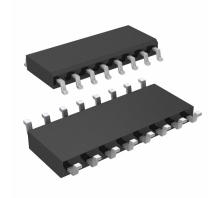
16-SOIC (0.295, 7.50mm Width)
Number of Pins
Number of Pins: Indicates the number of electrical connections available on the component. These pins are used to connect the component to other components or circuits on a printed circuit board (PCB). The number of pins determines the functionality and connectivity options of the component. It is important to ensure that the component has the correct number of pins for the intended application.
16
Operating Temperature
Operating Temperature is the range of temperatures at which an electronic component can function properly. It is typically specified in degrees Celsius (°C) and indicates the minimum and maximum temperatures at which the component can operate without experiencing damage or degradation. Operating Temperature is an important parameter to consider when designing electronic circuits, as it ensures that the components will function reliably in the intended operating environment.
-40°C~125°C
Series
Series, in the context of electronic components, refers to the arrangement of components in a circuit. When components are connected in series, they form a single path for current to flow through. The total resistance of a series circuit is the sum of the individual resistances of each component. Series connections are often used to control the flow of current in a circuit, as the total resistance can be adjusted by changing the number or type of components in the series.
Automotive, AEC-Q100
Part Status
Part Status is an electronic component parameter that indicates the availability and production status of a component. It is typically used to inform customers about the availability of a component, whether it is in production, end-of-life, or obsolete. Part Status can also provide information about any restrictions or limitations on the component's use, such as whether it is only available for certain applications or if it has been discontinued.
Obsolete
Moisture Sensitivity Level (MSL)
Moisture Sensitivity Level (MSL) is a measure of the susceptibility of a surface mount electronic component to moisture-induced damage during soldering. It is classified into six levels, from 1 (least sensitive) to 6 (most sensitive). MSL is determined by the materials used in the component's construction, including the solderability of its terminals and the presence of moisture-absorbing materials. Components with higher MSL ratings require more stringent handling and storage conditions to prevent moisture absorption and subsequent damage during soldering.
2A (4 Weeks)
Number of Terminations
16
Max Power Dissipation
1.2W
Technology
Technology, in the context of electronic components, refers to the specific manufacturing process and materials used to create the component. It encompasses the semiconductor fabrication techniques, such as the type of transistor used (e.g., MOSFET, BJT), the gate oxide thickness, and the interconnect materials. Technology also includes the packaging type, such as surface mount or through-hole, and the leadframe or substrate material. The technology used impacts the component's performance characteristics, such as speed, power consumption, and reliability.
Capacitive Coupling
Supply Voltage
Supply Voltage is the voltage required to power an electronic component. It is typically measured in volts (V) and is specified in the component's datasheet. The supply voltage must be within the specified range for the component to function properly. If the supply voltage is too low, the component may not function at all. If the supply voltage is too high, the component may be damaged.
12V
Approval Agency
CSA, UR, VDE
Voltage - Isolation
Voltage - Isolation refers to the maximum voltage that can be applied between two points in an electronic component without causing electrical breakdown. It is a measure of the component's ability to withstand high voltages without allowing current to flow between the points. A higher voltage isolation rating indicates that the component can withstand higher voltages without failing.
5000Vrms
Output Voltage
Output Voltage is the voltage level produced by an electronic component when it is operating. It is typically measured in volts (V) and can be either positive or negative. The output voltage of a component is determined by its design and the input voltage applied to it. For example, a voltage regulator will produce a fixed output voltage regardless of the input voltage, while an amplifier will produce an output voltage that is proportional to the input voltage.
100mV
Number of Channels
Number of Channels refers to the number of independent signal paths within an electronic component. It indicates how many separate signals can be processed or transmitted simultaneously. For example, an audio amplifier with two channels can amplify two separate audio signals, while a multi-channel data converter can convert multiple analog signals into digital data. The number of channels is a crucial parameter for determining the component's functionality and application.
1
Nominal Supply Current
50mA
Power Dissipation
Power Dissipation is the maximum amount of power that an electronic component can safely dissipate without being damaged. It is typically measured in watts (W) and is determined by the component's physical size, material properties, and design. Exceeding the power dissipation rating can lead to overheating, reduced performance, and even component failure.
1.2W
Output Current
Output Current is the maximum amount of current that an electronic component can deliver to a load without exceeding its specified operating limits. It is typically measured in amperes (A) or milliamperes (mA). Output Current is a critical parameter for selecting electronic components, as it determines the amount of power that the component can provide to a load.
2.5A
Voltage - Forward (Vf) (Typ)
2.5V Max
Current - Output High, Low
1.5A 2.5A
Rise / Fall Time (Typ)
20ns 20ns Max
Interface IC Type
BUFFER OR INVERTER BASED PERIPHERAL DRIVER
Current - DC Forward (If) (Max)
30mA
Propagation Delay tpLH / tpHL (Max)
60ns, 40ns
Common Mode Transient Immunity (Min)
30kV/μs (Typ)
Output Peak Current Limit-Nom
2.5A
Built-in Protections
OVER VOLTAGE; UNDER VOLTAGE
Voltage - Output Supply
9.4V~24V
RoHS Status
RoHS Compliant
The SI8220BD-A-IS is DGTL ISO 5KV GATE DRIVER 16SOIC , it is part of Automotive, AEC-Q100 series. they are designed to work as Isolators - Gate Drivers.SI8220BD-A-IS with pin details manufactured by Energy Micro (Silicon Labs). The SI8220BD-A-IS is available in 16-SOIC Package,it is part of the electronic component Chips.that includes Automotive, AEC-Q100 Series. they are designed to operate as Isolators - Gate Drivers.it is with Operating Temperature -40°C ~ 125°C.SI8220BD-A-IS with original stock manufactured by Energy Micro (Silicon Labs). The SI8220BD-A-IS is available in 16-SOIC Package.Generally IC chips offer Mounting Style features such as SMD/SMT, Package Case of SI8220BD-A-ISis designed to work in 16-SOIC (0.295", 7.50mm Width), it's Operating Temperature is -40°C ~ 125°C.The SI8220BD-A-IS is available in 16-SOIC (0.295", 7.50mm Width) Package, is part of the Isolators - Gate Drivers and belong to Isolators.SI8220BD-A-IS with EDA / CAD Models manufactured by Energy Micro (Silicon Labs). The SI8220BD-A-IS is available in 16-SOICPackage, is part of the Isolators.The SI8220BD-A-IS is Isolators - Gate Drivers with package 16-SOIC (0.295", 7.50mm Width) manufactured by Energy Micro (Silicon Labs). The SI8220BD-A-IS is available in 16-SOIC Package, is part of the DGTL ISO 5KV GATE DRIVER 16SOIC.
SI8220BD-A-IS More Descriptions
ISO Drivers Automotive 16-Pin SOIC W
DGTL ISO 5KV 1CH GATE DVR 16SOIC
Input Type: Opto, Output Configuration: Single, Peak Output Current (A): 2.5, Max. Prop. Delay (ns):80, UVLO Voltage (V): 8, Isolation Rating (Input-Output, kVrms): 5, Isolation Rating (Output-Output, kVdc): -, Overlap Protection & Dead Time Control: 0, Package Type: WB SOIC-16, Temperature Range (C): -40 to 125 -ᄚ, Input VDD (V): -, Driver Supply (V): 6.5 to 24